Showing posts with label chicken. Show all posts

Sunday, July 16, 2023

Upgrade: Chicken Cassoulet

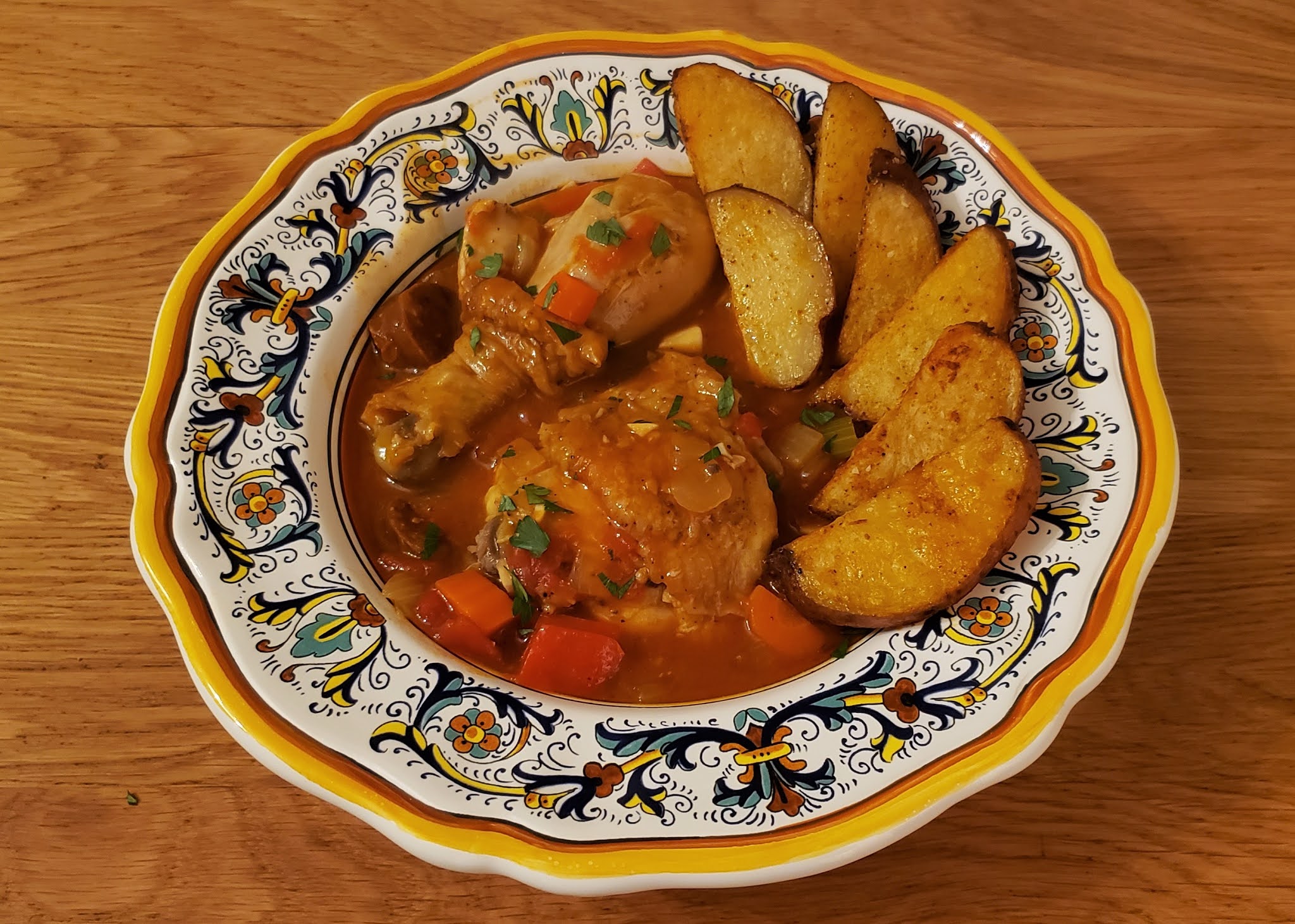
Bonne fête! No Free Lunch is back for another Bastille Day, albeit a touch late. After a few months off, I think it's appropriate to return with a dish that's personally important to me. I started making my chicken cassoulet shortly after Ariel and I moved in together about a decade ago. It quickly became a staple meal, to the point were we just call it "beans." This is not meant to be a traditional Occitan cassoulet, but it does adhere to the rustic spirit of the dish and is authentic to the way I like to cook. It takes humble ingredients and puts them together into a very satisfying meal. I thought this was a great time to update the recipe to how I make it now.

I've made a few small but important changes to my previous recipe. It turns out that stews like this freeze exceptionally well and are great to pull out for a quick dinner later. As such, I've scaled it up, but a bigger pan is needed. Although precision is not really needed for something like this, I've also weighed out the vegetables for more clarity as there is a lot of variance in the size of onions and carrots. For the chicken, I now recommend bone-in pieces as there is flavor to be had in the bones. I usually pull the meat off the bones after cooking and return it to the stew to serve. This makes it easier to portion out and easier to eat, especially if you have to hold a baby. If you like the presentation with whole chicken pieces, skip that step. 

Many great dishes balance richness and acidity, which I now get done with a little butter and sherry vinegar at the end. This should be done to taste - you can always add vinegar but can't take it away. I no longer recommend my old method of cooking the stew with a lemon as it can add bitterness. My last change is in the beans. The cooking orthodoxy (which I once followed) says to always drain and rinse canned beans. I think this arose from older generations who thought of canned food as a little unclean. For me, this changed from making Kenji's white bean soup, where he notes that there is flavor to be had in the bean liquid. If making a bean salad, I would still rinse, but in a stew, leave it in. I drain two of the cans to make room for some chickens stock, but don't bother with rinsing. I served with a little parsley for color and some crunchy baguette toasts.

Sunday, August 21, 2022

Upgrade: Portuguese Chicken (葡國雞)

Portuguese chicken (translating literally to pou gwok gai in Cantonese, pu guo ji in Mandarin, and galinha à portuguesa in Portuguese) is a dish that fascinates me endlessly. It's a fusion of east and west that could only have been born in its own specific context. Back when I wrote about it in 2012, I noted that little was written about it (at least in English) on the internet. There's quite a bit more now, but it's still not a widely known dish. It also doesn't show up in any of my Chinese cookbooks. I still don't know if my version is authentic, but I can tell you it tastes good and improves upon my previous one in many ways. One of those can be seen in the photo, where the deeply colored sauce appeals a lot more than the bright yellow of my previous attempt.

Despite the name, Portuguese chicken does not originate in Portugal, but rather the bustling southern Chinese city of Macau, which was an outpost of the Portuguese empire for over 450 years. The food of Macau blends Cantonese cuisine with influences brought from around the world by Portuguese traders. As such, Portuguese chicken features some ingredients not commonly seen in other Chinese dishes. Most recipes feature five main components: chicken, potatoes, onion, coconut milk, and turmeric but diverge from there. Other possible additions include sausage, olives, and bell peppers. Some are simmered on the stovetop, while others are baked as a casserole. In some versions, the casserole includes rice on the bottom or desiccated coconut sprinkled on top. I decided to keep it simple and stay on the stove in a wok. This also makes it easy to thicken and adjust the sauce at the end.

After I wrote my original post, I found out I was not the only member of my family to be a fan of Portuguese chicken. As it turns out, my grandma went to school in Macau for a time and enjoyed it regularly. She informed me back then that my version was incorrect because the chicken and potatoes should be cut into smaller pieces. Cutting smaller does make more sense to eat with chopsticks and also helps everything cook more quickly. Another change I made was to crank up the seasoning and build a more complex flavor in the sauce. I also chose to marinate the chicken this time. Sources vary greatly on what should go in the marinade, but I went with a classic Chinese style. I included just a little dark soy sauce for color - don't overdo it. Some recipes use more spices in the marinade, while I put the into the sauce instead. I did not have any Portuguese chouriço (in fact, I have no idea where one can buy such a thing) but did have some Spanish chorizo on hand that worked well here. Some Cantonese lap cheong would also probably do just fine. The versions I recall from Shanghai did not include any sausage, and that works as well.

Tuesday, June 21, 2022

Parmesan Garlic Wings

Chicken wings are a perennial favorite in our house. We order them frequently at restaurants and for takeout and also make them at home. While I still love Buffalo-style wings (as seen in my 2015 recipe), I've been experimenting with parmesan garlic wings lately. The air fry setting on our convection oven gives great, consistent results. A combination of potato and corn starch as a coating helps get the wings crispy and helps them hang onto the sauce. Of course, the wings can be deep fried instead but air frying reduces the hassle and mess.

This recipe is the culmination of several test runs over which I've made many adjustments. In the first attempt, I cooked the garlic in butter and added the cheese, which promptly fused together into a big mass. I realized what I needed was some liquid for the cheese to melt into, creating basically a thicker version of sauce Mornay (last seen on this blog as part of a croque madame). This creamy style of wings is commonly found at midwestern bars and pizza joints, like Vermillion's own Old Lumber Company, although mine might be a bit more complex. For a version omitting the cream, the wings could simply be tossed in the garlic butter and sprinkled with grated cheese before serving. 

The sauce is on the rich side, so I've made some adjustments to make the dish more balanced. Red pepper flakes add some background heat to the wings, but I don't add enough to make them overtly hot. A little lemon juice adds some much-needed acidity to a sauce that can otherwise be one note. Both of these elements can (and should) be adjusted to taste. The sauce is meant to be quite thick so it can coat the wings, but it can easily go too far into a paste-like consistency. It does thicken as it cools, so the wings are best served immediately when the sauce is ready. The parsley garnish is optional, but a little green goes a long way for the presentation.

Sunday, March 20, 2022

Buffalo Chicken Quesadilla

Back when I was a student at Carnegie Mellon, one of my favorite campus dining options was a place in the University Center called "Si Señor." Most people tried a wrap or a taco and dismissed it as a subpar Chipotle imitation. My friends and I, though, considered ourselves real connoisseurs of the lesser known offerings further down the menu, from Buffalo wings to lamburgers to a fried frankfurter covered with onions and peppers. The "Pittsburgh wrap" filled with French fries (in the style of Primanti Brothers) was another classic item. Over the years, the menu grew with various pieces of paper taped to the wall. Sadly, Si Señor closed shortly after I graduated, but the memories live on over a decade later. 

Among all these items, the Buffalo chicken quesadilla stands as my overall favorite, most frequently ordered meal, and the one I most wanted to recreate all these years later. There is no shortage of recipes for such a thing online, including one from the Frank's RedHot website. Like everything they did, the Si Señor version is a little different. The chicken (also available in a wrap if so desired) was bathed in a creamy, pale-orange sauce and was relatively mild. The quesadilla was made from an enormous tortilla, folded into a square envelope and crisped on a flattop, held down with a trowel. It was served cut in half with a choice of side and a small brownie known as a "sweet treat." Although not exactly the same, my version does capture the spirit of the original. 

As a student, I always wondered what exactly went into the Buffalo chicken and a few months back, I went digging using the Internet Archive's Wayback Machine. I managed to dig up a 2006 menu from the CMU website with the description: "Buffalo Chicken ~ marinated in hot sauce, baked and tossed with light mayo, blue cheese and spices. (hot)." With just this and my memory, I created this recipe, which turned out rather well. The only change I made is adding more Frank's to the final sauce to crank up the Buffalo wing flavor and make it a little spicier. I typically ordered the quesadilla with what the old menu calls "Morelia" hot sauce, so I think this works well. The leftover chicken (this recipe makes way more than is needed for one quesadilla) is also good cold as a chicken salad. Try adding a little celery. For the quesadilla itself, I went with the more typical half-moon form factor. The traditional cheese to use for quesadillas is Oaxaca from southern Mexico, but anything that melts well is good. I used Chihuahua cheese, which originates in northern Mexico (the brand I use, VV Supremo, is from Wisconsin and can be found at Sam's Club). Mozzarella is a good substitute if neither are available. 

Sunday, October 31, 2021

Chicken Stock

October always seems to be an especially busy time in the world of academia, and I haven't had a lot of time to do much innovating in the kitchen. In times like these, I usually fall back on easy standbys like braised chicken or pan-fried salmon. Another reliable easy meal: the good old Sam's Club rotisserie chicken. Only $5 provides a few days worth of meals. We usually have a few pieces of it for dinner, then make the rest into chicken salad. It's a good deal even if the carcass goes in the garbage, but why not use that, too?

Chicken stock is probably one of the most frequently appearing ingredients on this blog. I use it all the time. I always keep a few cartons of Swanson's on hand, but when I can, I make my own. There are few things easier to make: just toss some chicken and vegetables into a pot, heat, and walk away for a while. The rotisserie chicken works perfectly, but you can also keep bones and wing tips in the freezer to make into stock. For the vegetables, I used the classic onion, carrot, and celery combination, but it's flexible. Scallion and ginger could also be used for the Chinese version, similar to the shrimp stock I've posted before. Stock freezes well. I often use 16-oz. takeout containers.

Wednesday, May 26, 2021

Diced Chicken with Walnuts (桃仁雞丁)

To kick off the summer, we're taking on another recipe from Pei Mei's Chinese Cook Book. This one is adapted from one I found in the Southern China section of volume I. The Chinese name taoren jiding translates to "walnut diced chicken." Interestingly, this recipe bears a striking resemblance to what most Americans picture as Chinese food. American-Chinese cuisine evolved specifically from Cantonese cooking, and this dish is a clear predecessor. Some combination of meat, vegetables, and nuts stir fried together in a sauce is a formula that comes up again and again. Years ago, even I threw together a cashew chicken recipe that's not all that different to this. 

I made a few changes from Pei Mei's original. As with so many of her dishes, she deep fries the chicken. I decided to streamline the process by stir frying the chicken instead, avoiding the hassle of cleaning up so much oil. I might try it that way in the future. She also recommends using hot peppers, while I used bell peppers. Some or all of those can be substituted for something spicier if you so choose. I chose to not salt the sauce ahead of time. You can always add salt at the end if you want to, and I added a few pinches. It's also worth mentioning she approves of cashews a substitute for the walnuts. 

This dish came out well. In the past, I've typically minced ginger, but I liked the bursts of ginger here from the larger slices. I might put in a little more next time. The flavor profile is pretty classic. A little more sugar would likely tilt it in American-Chinese direction, if you're into that. There's also plenty of leeway in the choice of chicken. Pei Mei suggests either deboning an entire (small) chicken or using breasts. I used thighs here. I served with steamed rice to complete the meal.

Saturday, April 3, 2021

"Matchos" with Shredded Chicken

Every Passover, we try to shake up the tired old menu a little. This has yielded some pretty great results in the past, with scotch eggs being the most enduring favorite. Last year, we tried making a "matzo pizza." It was okay, but with all the wet sauce on the matzos, it ended up a little too soft. That gave me the idea to try making matzo nachos, which I'm calling "matchos." The result was pretty delicious, and I'd recommend giving this a try for something a little different at the end of Passover.

The topping for the matchos is a shredded chicken similar to what we put in the kolaches back in December. For a Jewish twist, I sautéed in schmaltz (I made a big batch at the beginning of the week), but you can certainly use olive oil or vegetable oil. The sauce is thickened with potato starch to keep things "KFP." If you really want to go nuts, use some leftover brisket as the topping, but I went with a more traditionally nacho flavor profile. The matchos only use about half of the chicken. It freezes well, so it can be saved for tacos or regular nachos once Passover is done.

For the cheese, I used cheddar, but almost anything that melts well will work. I would probably use a little more next time, but this is what I had. We rounded out the topping with sour cream, guacamole, and diced onions, but those are all just suggestions. I made my own guacamole, but if you have some from the store and make the chicken ahead, the dish comes together pretty quickly. If nothing else, I'm inspired to make nachos with actual chips sometime soon.

Sunday, December 13, 2020

Savory Kolaches

Going to the farmer's market every Saturday was one of our favorite things to do in Bloomington. While we certainly enjoyed the produce on offer, we really went for the breakfast options. Whether that was crepes and croques at Le Petit Café, Brown County Coffee, or Aahaa Chai, there was always something tasty to be found. Our all-time favorite, though, was Sweet Claire Bakery, which always had a line around the corner. It is here we were introduced to kolaches: sweet buns with lots of different filling options. More than two years after we left town, we have greatly missed them... until now. Ariel got in touch with the proprietor and got the dough recipe, and I went to work dreaming up some fillings. We were blown away with how good the results were, and I'm excited to share them.

Kolaches originated in Central Europe, like so many other delicious things, made their way to the United States with the immigrants who loved them. Czech communities have made them especially popular in Texas. From what I can tell, the original Czech version has strictly sweet fillings, but creative American cooks have moved them in a savory direction. We came up with two fillings, loosely inspired by what we remembered from the kolaches we had in Bloomington. Both types were delicious.

The first is a braised chicken I've been calling "adobo chicken," not to be confused with the grilled version I posted last summer. This was fairly similar to my pulled pork recipe, but uses chicken thighs and tomatoes. It's a little spicy on its own, but this balances out inside the bun with. The filling is rounded out with half a hard-boiled egg. The chicken turned out very well and would also be great in a taco. Because it is a saucy filling, there were some structural problems on the bottoms, so it's important to make sure they are thick enough to hold up. It wasn't too bad, but it's something to watch out for. The second emulates a classic breakfast sandwich with sausage, egg, and cheese. The main question here was how to do the eggs. I decided to make French-style rolled omelettes and put half an omelette in each kolache. This worked out very well because they hold up well while not drying out. These kolaches turned out great. The only adjustment we would make is adding a little more cheese. 

The dough recipe is reproduced from what we received from Sweet Claire. The original recipe was given in baker's percentages, with this set to make 12 kolaches. As such, the amounts are all in grams - a little unusual for this blog. A good scale is a great addition to any kitchen. We made 6 of each type of kolache. The chicken recipe makes enough for all 12 buns, so I saved half of it for later. All in all, the results were simply fantastic, and we're already looking forward to making them again and trying some different fillings. 

Friday, September 25, 2020

Spanish Chicken Stew

Braised chicken has become one of my favorite things to cook and eat in recent years. It's pretty hard to mess up, and produces great results for a low cost and mostly inactive cooking time. Recent examples have included a Chinese and a French version, as well as one that sprang from entirely my own brain. I planned out this chicken stew to emulate a Spanish flavor profile, using paprika, chorizo, and sherry vinegar. I don't know if this is something that would actually be made in Spain, but it turned out well. The paprika and chorizo give it a hint of heat and the vinegar lends a subtle, tangy acidity. 


The chicken is the central ingredient here, and I used three leg quarters, which I split apart into legs and thighs for more even cooking. A sharp knife should go easily through the tendon. Leg quarters are one of my top three cuts for braising, along with pork shoulder and beef chuck. They are very economical. Locally, we can get a 10 pound bag for just a few dollars. These particular quarters were quite roughly butchered (probably a reason for the low price), each with a piece of the backbone still attached. I put in the time to take the backbones off, which I froze to be made into stock later. In these crazy times, I found this simple task quite mentally therapeutic. Taking off the backbones also improves the presentation of the thighs.

The chorizo used here is the Spanish variety, which is a firm, cured sausage flavored with paprika. It can be eaten as-is, or as an accent ingredient as I've done here. This differs from Mexican-style chorizo, which is a fresh sausage that is great in tacos or quesadillas, but not appropriate here. I also continue to experiment with potato starch as a thickener, which has been working quite well. It's definitely become a staple in my kitchen for both thickening and breading. I went with roasted potatoes to accompany the stew, but you could definitely use mashed potatoes, rice, or noodles.

Saturday, September 5, 2020

Chicken Caprese Sandwich

Chicken sandwiches are a popular lunch choice at our house, and are a great way to use leftover chicken. Since discovering the dish a few years ago, cotoletta alla palermitana has become one of my favorite chicken dishes to make, especially in the summer. Enjoying a daiquiri while tending the grill makes it even better. I usually make extra so we have some for lunch the next day. Although I highly recommend trying the grilled version, any cutlet, such as a chicken schnitzel or katsu, will work for a sandwich. These sandwiches, which combine the chicken cutlets with flavors from the classic caprese salad were one of our favorites.

I made the pesto in a mortar and pestle using homegrown basil. We used most of it for pasta the previous day and had a little left for this. Mixing the pesto with Kewpie mayonnaise makes for a delicious spread. The tomatoes also came fresh from the garden. The buns Ariel made for the Jucy Lucy were such a hit, she made some more, which we used here. Any kind of good bread will work. As with many people, the pandemic has been an opportunity for us to explore homemade bread. 

Thursday, July 16, 2020

Chicken and Mushroom Sandwiches

There aren't a lot of restaurant options in Vermillion at the best of times, but back when we could go out, Mr. Smith's was always one of our favorites. Nestled inside the local Ace Hardware, it's a great spot to go for a sandwich, fried chicken, or a loaf of bread. Ariel's favorite sandwich there is the portabella chicken breast. As we're staying home as much as possible, I decided to recreate the sandwich at home. This recipe makes four sandwiches. We enjoyed two with sautéed yellow squash from the garden and saved two for lunch the next day.


As the name suggests, the original sandwich uses chicken breast and portabella mushrooms. I cheated a bit and used chicken thighs and cremini mushrooms instead, which are what I happened to have available from our Costco run last week. The chicken is simply seasoned with lemon pepper, but if you have a preference for something else, go for it. For the bread, I used soft potato rolls. While these are great for hamburgers, I would ideally use something a little heartier. For toppings, we added some romaine lettuce, sliced avocado, and Kenji's ranch dressing.

As I don't tend to order the sandwich, I can't personally attest to how close it was to the original, but it did taste good, and Ariel approved. As sandwiches go, the filling was quite loose, so eating them was a bit of a mess. A better bread choice would have mitigated that problem, I think. If preferred, the sandwich filling could also be adapted as a rice or pasta dish, similar to my chicken and bell peppers. To do this, I would deglaze the pan with a little white wine and chicken stock, reduce and thicken with potato or corn starch. 

Sunday, July 5, 2020

Grilled Adobo Chicken

Grills usually come to life when the weather warms up, especially in places where the winters are cold. I actually don't use the grill as much as I used to, which may be partially due to having a better indoor stove than our last house. It's also because I've discovered I can do a lot of "classic" grilled foods (burgers and steaks, particularly) better in a cast iron pan. That being said, there are quite a few dishes I always prefer to do on the grill. Boneless chicken thighs are probably my favorite thing to grill. They do well cooked to a high internal temperature, which gives ample time to develop browning on the grill. Taking out the bone allows more even cooking that doesn't take forever. My most common ways to prepare them are breaded cutlets and this marinated Mexican-styled chicken that's perfect for tacos, quesadillas, and the like.


We call this dish "adobo chicken" because it uses chipotles in adobo sauce, along with some of the sauce, in the marinade. It has nothing to do with the classic Filipino dish "chicken adobo," which is a vinegary chicken stew. Chipotles in adobo are a great product. You can take a few out with a little sauce to add a little Mexican flavor to anything, while reserving the rest in an airtight container, where they will last for months. Chipotles are smoked jalapeños, and as such are quite spicy. I remove the seeds to tone down the heat. Avoid touching your face after working with hot chili peppers of any kind. 


This chicken would be perfectly good as-is with some rice and beans, but we often use it as an ingredient. We made quesadillas with homemade tortillas from The Art of Mexican Cooking by Diana Kennedy. Making tortillas was easier than I expected, and are much better than the grocery store bagged ones. It's not something I would do all the time, but they are a nice treat if you have some lard on hand.

Friday, July 3, 2020

Noble Consort Chicken (貴妃雞)

A few weeks ago, a recipe in the Joyce Chen Cook Book called "Empress Chicken" caught my eye. I did a little translation of the Chinese name guifei ji, and discovered the real name is a little more interesting. The Chinese word ji means chicken, but guifei is more accurately translated as "noble consort." In Chinese history, a noble consort was one of the emperor's high-ranking concubines, who ranked just below the empress. I found a few websites claiming the dish was named for a specific Tang dynasty concubine, but like most food origin stories, this is almost certainly apocryphal. What the dish has to do with concubines is anyone's guess.


The dish itself is a classic example of a Chinese-style stew, known as hongshao, or "red cooking." I've made a few of these over the last couple of years, but this is the first to make it to the blog. The basic ingredients are soy sauce, sugar, and a selection of seasonings. Seasonings can include ginger, star anise, cinnamon, or bean pastes. This is the first one I've made that included mushrooms, and I found them a terrific addition. I use black mushrooms (dried shiitakes) a lot in various dumplings and stir-fried dishes, but stewing brings them to life in a new way. They basically last forever, so I tend to stock up when we go to Chinese stores. I used Chinese rock sugar in this dish, which is the traditional choice for this type of stew, but white sugar is fine if you can't get it.

Chen calls for 4 wings and 4 legs. Although I like chicken legs, I went with all wings for consistent cooking time. I scaled the whole thing up a bit to use a full package of wings I found at Walmart and played around with the proportions of ingredients based on what I like. The chicken comes out very tender, and the stewing liquid is full of flavor boosted by the mushrooms. That being said, the difficulty I tend to run into with hongshao dishes is that you have a ton of liquid at the end that is too watery to work as a sauce, but as you reduce it down it gets too salty. I don't think this is the traditional choice, but I think corn starch or some other thickening agent is the way to turn it into a sauce. I used 1/2 tablespoon, but I do think it needed more. I plan to experiment more with honghsao dishes, so you can expect to hear more on this soon.

Thursday, June 25, 2020

Upgrade: Pan-Roasted Chicken with Onion Gravy

Today's upgrade is based on a chicken recipe I wrote back in 2012. While there's nothing wrong with that one, it was quite basic, consisting of a pan-roasted piece of chicken with a simple onion gravy. I wanted to do something a little more interesting this time. The gravy has some real complexity. I cooked the onions longer than what you would normally do for a pan sauce, which brings out more sweetness. This balances well with the rendered fat from the chicken skin, salty soy sauce, and tart lemon. This recipe makes more than enough sauce for the chicken, and pairs perfectly with mashed potatoes. 


Leg quarters are quite underrated, I think. We got a big, deeply discounted bag of them a few weeks ago (the first use was smoked chicken) and have them ready to go in the freezer. When we were wedding planning last year, we had to get a kosher caterer for a handful of guests. The menu they provided had "chicken bottoms," which we had never heard of. Turns out, it's another term for leg quarters. The only references I can find to this term come from kosher websites. I always find these linguistic peculiarities fun.

As I've mentioned before, we are on a two-week grocery cycle, in which we carefully plan out 14 days worth of meals to limit exposure. I then categorize the meals based on how fresh the ingredients need to be. This is a perfect meal for the back half of the cycle. The fresh ingredients (potatoes, onion, and lemon) hold up well being stored. I harvested the rosemary from the garden. I highly recommend growing herbs that are better fresh than dry and are typically used in small quantities. This way, you can harvest a little instead of buying a big bunch that will go bad before you can use it. As such, I have rosemary, parsley, mint, and basil in the garden. Everything else in the recipe is a pantry staple. 

Tuesday, June 2, 2020

Beijing-Style Smoked Chicken (燻雞)

Pei-Mei's Chinese Cookbook is a source of endless fascination for me. The three-volume set has been my main reference for Chinese food for the last six years. With hundreds of recipes from all over China, the breadth is not lacking. Sometimes, however, the depth does. As I've mentioned before, every recipe is exactly one page long, shown on facing pages in Chinese and English. Inevitably, this means quite a few recipes are pretty low on detail. Sometimes the instructions don't make sense, which is probably a combination of translation and a general vagueness you see in 1960s recipes of all origins. 


Most of the time, Pei-Mei hasn't steered me wrong, although I do often make adjustments to modernize the recipes or make them more accessible. This time, I tackled her Beijing-style smoked chicken. I had not, until attempting this, ever smoked food before, so I didn't really have a baseline for what to expect. Although the final product was pretty good, I floundered around a bit with the instructions as the heat  levels and cooking times Pei-Mei suggests were way off. As such, I'll provide more commentary than usual in the instructions section. I plan to do an update post next time I try the dish.

Despite the confusing instructions and some of my own mistakes, the chicken came out well. It was almost startling how much smoky flavor made its way into the meat, which was also still quite juicy. I served with rice and stir-fried broccoli and garlic. 

Tuesday, May 26, 2020

Oyakodon (親子丼)

Oyakodon is a classic Japanese dish within the broader category of donburi, which all consist of a bowl of rice topped with some kind of meat, seafood, or vegetables. Common examples are katsudon (sliced cutlets with egg), unadon (grilled eel), and tekkadon (sliced tuna). The word oyakodon translates to "parent and child donburi," referring to the main ingredients of chicken and egg. Of all the varieties of donburi, oyakodon is one of the easiest to put together at home and is always satisfying. I served it with Japanese potato salad.


It is interesting how different the ethos of Japanese cooking is to that of Chinese. Both cuisines emphasize umami-rich ingredients, but very different ones. Chinese food gets a lot of its punch from fermented bean products, which are much funkier and in-your-face than the kombu (dried kelp) that powers so much of Japanese food. Japanese flavors are subtle, and oyakodon is a perfect example. The entire dish is gently simmered in broth with no searing and no frying. Although sushi tends to get most of the fanfare surrounding Japanese cuisine, humbler dishes like this one deserve some attention, too.

Dashi is the main unusual ingredient here. In a previous post, I mentioned substituting chicken stock for dashi for practical reasons. I no longer condone that substitution, as I consider dashi to be the quintessential Japanese ingredient. The aroma of simmering dashi and soy sauce just can't be missed here. I have had success finding both ingredients in Asian stores, but you can also use powdered instant dashi. I now recommend Marc Matsumoto's dashi recipe, and I consider him a go-to resource on Japanese cooking. I also usually put a little mirin into my oyakodon, but it's not essential, and I wouldn't run out to get it just for this, especially if you're limiting grocery runs these days.

Friday, May 15, 2020

Pan Roasted Chicken with Mustard Sauce

Like a lot of my dishes, this pan roasted chicken evolved over time until I decided it was ready for the blog. Usually just called "mustardy chicken" (not to be confused with the breaded version) in our house, it quickly became a family favorite after I first came up with it a few years ago. When we moved to South Dakota and all our belongings were stuck in warehouse purgatory back in Indiana, we bought a pair of cast iron pans (pictured in this post) at Costco, and this was the first dinner I made. Although it tasted especially good that day, I recommend classing it up a little and not eating off disposable foam plates. 


The recipe lends itself well to variation. The thighs can easily be swapped out for breast. While it does work best with skin on, the skin can be removed, if desired. A little more oil will need to be used without the fat from the skin. Most herbs will work fine. I frequently make it with tarragon, but our chives recently came back for spring, and I used those. Being close to the end of our two-week grocery plan, we didn't have much left in the way of sides. I had a few potatoes left, which I sliced thin and sautéed with butter while the chicken cooked.

Sunday, April 26, 2020

Pollo a la Plancha

Last month, I wrote about trying a Cuban dish called pollo a la plancha during our San Diego trip. It's a simple dish consisting of chicken cutlets grilled on a griddle and topped with onions. I was surprised with how much I enjoyed it. A few weeks ago, I threw together my own version for a quick Passover-friendly lunch. Ariel later told me how much she liked it, which is usually a one-way ticket to a blog post. As I'm not too experienced with Cuban cuisine, I won't claim this is particularly authentic, but I can guarantee it is delicious.


My original version used a boneless, skinless chicken breast butterflied and separated into two cutlets. This time, I had some thighs on hand instead. I think either cut works equally well, so go with whatever you have. This recipe ends up using only half an orange and about 3/4 of a lime, so I encourage you to use the leftovers to make yourself a drink. I served with rice, but a salad works, too.

Sunday, April 12, 2020

Kosher for Passover Chicken Schnitzel

We're living in a strange time. It's been interesting noticing how people have responded to our new reality of social distancing. Since people are going grocery shopping far less frequently, buying habits have changed. We made a large Sam's Club run a few weeks ago, and they were completely out of dark meat chicken. Our local Hy-Vee and Walmart were also out of dark meat. Perhaps this is a reaction to the relatively low prices of these cuts. As is well-known on this blog, the thigh is my favorite part of the chicken, so I've had to deal with boneless, skinless chicken breast for basically the first time ever. 


Continuing on the theme started with my kosher for Passover scotch eggs, I wanted to do another easy variation of a classic dish that can be done for Passover. Pounded thin and fried as a schnitzel, the potential dryness of chicken breast is less of a problem, though I do still prefer thighs for chicken cutlets (see Cotoletta alla Palermitana). To substitute thighs in this recipe, use two boneless thighs instead of one butterflied breast. 

I use the basic flour-egg-breadcrumb breading technique here, substituting matzo cake meal (finely ground matzo) for flour and regular matzo meal (coarsely ground matzo) for breadcrumbs. The result mimics the traditional schnitzel, but with that distinctive matzo flavor in the background. As a final note, I used canola oil for frying, which is kitniyot, a broad category of foods avoided by some, but not all Jews during Passover. Ariel typically doesn't eat kitniyot, but usually makes an exception for cooking oils. If you want to avoid this, an alternative oil or schmaltz could be used.

Sunday, December 8, 2019

Braised Chicken and Mushroom Pasta

We'll return to San Diego shortly, but in the meantime let's dive into some more chicken. Like so many of our family favorite recipes, this one happened by accident. A few weeks ago, Ariel was on her way home from a work trip and it was up to me to have dinner ready when she arrived. I had some chicken and not a lot else. I was thinking about making chicken chasseur again, but didn't have any tomatoes. What I did find was a jar of mixed dried mushrooms. These have a ton of flavor and are a great thing to have on hand. This particular jar came from World Market. The dish came together beautifully, and this is my best attempt to recreate it. 


This recipe utilizes one of my favorite tricks, which I haven't featured on the blog before. I got the idea of using Parmesan rinds in soups and braises from Kenji's "Tuscan" bean soup recipe, which imparts some extra flavor as the sauce cooks. Every time I buy a wedge of Parmesan, I cut the rinds off and freeze them so they are ready to go any time. Similarly, whenever I use chicken thighs, I trim off the excess skin and save it to make schmaltz. Whenever I use shrimp, I save the shells to make soup. There's flavor hiding in these scraps - don't throw them away!

One last note: this is the first post using our beautiful new dishes from our wedding registry! The color is a nice contrast for this decidedly brown dish.

Ingredients
  • 4-6 chicken thighs
  • 1 large onion, sliced into strips
  • 5 cloves garlic (adjust to taste), minced
  • 2 Tbs flour
  • 1 cup dry red wine
  • 3 cups chicken stock
  • 1 tsp dried oregano
  • 1 bay leaf
  • 1 cup (about 50 g) dried mushrooms (I used a mix of oyster, shiitake, porcini, and black trumpet)
  • 4 inch piece (about 50 g) Parmesan rinds
  • 1 lb dry pasta
  • Olive oil
  • Salt and black pepper

Instructions

Trim excess skin from chicken and season both sides with salt and pepper. In a large sauté pan or similar vessel, heat a little olive oil on medium-high heat. Cook the chicken, starting skin side down, until browned on both sides and the skin has rendered. Remove chicken and set aside, but do not drain the pan.


Drop heat to medium and add the sliced onion to the pan. Season with salt and pepper and cook, stirring frequently, until softened. 


Add garlic, stir together, and cook another minute. Add the flour, stir together, and cook another minute. Deglaze the plan with wine, scraping up the bottom of the pan. Reduce briefly, then add the chicken stock. Stir in the oregano, bay leaf, mushrooms, and Parmesan rinds. Place the chicken back in the pan. Bring to a boil, reduce to a simmer, and cover. Simmer for about 40 minutes. 


While the chicken cooks, cook the pasta. You can undercook it a bit, as it will finish in the sauce. When the chicken is done, remove from the pan and set aside. Turn the heat up to high and reduce to desired thickness, about 5 minutes. For the last minute, add the pasta to the pan and toss until well coated. 


Serve with grated Parmesan and bread.