Showing posts with label yogurt. Show all posts

Friday, July 31, 2020

Tzatziki

We've recently been eating gyros with some frequency. Decent quality frozen gyro meat can be found at both Sam's Club and Costco, and make for an easy dinner. We upgrade the meal with homemade pitas and tzatziki. Tzatziki is not hard to make, and works very nicely both as a topping for gyros and as a dip for chips or crackers. Although our garden failed to produce cucumbers this year, making tzatziki was a good way to use them up last summer. 


My tzatziki is based on one from Wanderlust Kitchen, but I've made a few adjustments. The main thing is that they recommend allowing the grated cucumber to drain overnight, which I find simply does not work. Instead, I recommend pressing the water out by hand. I happen to be out of white vinegar, but had plenty of fresh lemons for cocktails. This works completely fine. Basically, use whatever means available to get some acidity in there. Adding some chopped herbs at the end is nice, if they are available. I used spearmint from the garden this time. Mint and lamb are a classic combination, so this makes sense if using for gyro sandwiches. 


We made our gyro sandwiches with sliced white onion, tomato, and chopped romaine lettuce. For the pitas, we've been using Molly Yeh's recipe. We're still experimenting with how to perfect them and get them to puff up. In any case, they are a lot better than store bought once, which aren't the easiest thing to get around here.

Tuesday, July 14, 2015

Flammekueche (Tarte Flambée)

Bonne fête and welcome to the 2015 edition of the No Free Lunch Bastille Day special, which I think is fair to say has become a tradition here. This time, we head to Alsace for flammekueche, known in French as "tarte flambée." It translates roughly as "flame cake," but can be thought of as a thin crust pizza. Although flammekueche is not part of the "core" library of French cuisine, it is an Alsatian classic. In a way, Alsatians were the first to celebrate Bastille Day, storming the Strasbourg city hall just a week after the Bastille fell. Today, we salute their revolutionary spirit.


Alsace is one of the world's fascinating border regions, being passed from the Austrian-led Holy Roman Empire to Burgundy, to France over the years. Seized by Otto von Bismarck in the Franco-Prussian War, Alsace became a part of the German Empire until returning to France, where it has remained, in the Treaty of Versailles. Traditional Alsatian cuisine is a testament to the cultural blending that came out of this history. Where else in France is sauerkraut a central part of the cuisine? Their coq au vin is even made with Riesling. In fact, the first time I had flammekueche was in Germany.

As with many traditional dishes, my investigations turned up a lot of variation. The biggest differences are in the dough. Some use yeast and rise the dough, while others do not. Since the Wikipedia article describes it as "bread dough" I went the yeast route. There are also a variety of takes on the topping. I had decided on a mix of crème fraîche and fromage blanc, a tart fresh cheese from France. I was unable to get fromage blanc, so I am substituting fat free Greek yogurt. I also had some of the crema Mexicana left from the corn, and used that in place of crème fraîche.

Ingredients

Dough
  • 2 1/2 cups all-purpose flour
  • 2 1/4 tsp (1 package) dry active yeast
  • 1 tsp salt
  • 1 cup warm water (105-115 degrees F)
Topping
  • 3/4 cup crème fraîche (substitute crema Mexicana)
  • 3/4 cup fromage blanc (substitute fat free Greek yogurt)
  • 1 onion
  • 6 strips thick-cut bacon
  • Salt and pepper to taste

Instructions

Dough

Start by preparing the dough about 2 hours ahead of time. Mix the flour, salt, and yeast in a large bowl. Make a well in the center and pour the water in. Slowly mix the flour into the water until everything is integrated. 
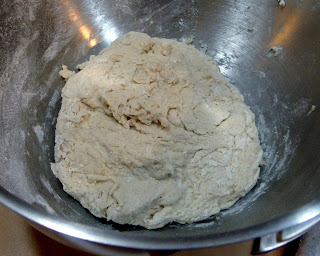
Before kneading
Knead until smooth. I did this in the stand mixer. Note the dough is quite sticky compared to bread dough. 

After kneading

Transfer the dough to a large, lightly oiled bowl. Cover with plastic wrap and let rise for 1 hour. Punch down, cover again and let rise for 1 more hour. Punch down again and divide the dough in half.

Assembly

Preheat the oven to 500 degrees F. Halve the onion and cut it crosswise as thin as possible. Cut the bacon into thin strips, about 1/4 inch wide. Mix together the crème fraîche and the fromage blanc/yogurt. 

Ready to bake

Roll both pieces of dough into large, thin rectangles. Transfer to oiled sheet pans. Spread the topping mixture over both, and sprinkle onion and bacon on top. Salt and pepper to taste. Bake on lower rack for 15 minutes. Cut into squares for serving. Wine pairing would traditionally be Riesling, but Vouvray did nicely today.

Saturday, July 4, 2015

Chicken Kebabs

Cooking a great meal can be the source of much pride and satisfaction. Sometimes, that satisfaction comes from doing lots of research, gathering ingredients, and pulling off a long, complex recipe. Something like Shanghai-style dumplings comes to mind. Other times, though, coming up with a simple dish on your own and having it exceed expectation can be just as satisfying. With just some chicken thighs on hand, I started looking at some Turkish kebab recipes and came up with this. The result was incredibly delicious. The chicken gets a good char, but is nice and juicy on the inside. They are just a little spicy, but not overwhelming at all.


I found out after the fact that yogurt-marinated chicken kebabs are called şiş tavuk in Turkish. I believe this is pronounced something like "sheesh tah-vook." It occurs to me that Turkish cuisine is one that hasn't quite caught on the US in the way that a lot of others have. If only we had a döner stand on every corner like the Germans do. On a side note, I still remember the first jet lagged kebab we had after touching down in Munich so many years ago, so it must have been pretty good!

A quick note on equipment: The use of metal skewers, from what I've heard, is preferred for chicken because the skewers conduct heat to the center of the meat, whereas for beef, wooden skewers are preferred. Besides, I love an opportunity to use my fun Turkish-styled skewers that invoke images of the Janissaries marching around the Ottoman Empire. Or maybe that's just me. 

Ingredients

  • 4 lb boneless chicken thighs
  • 2 cups plain Greek yogurt (I used fat free)
  • 1 Tbs cumin powder
  • 1 Tbs paprika
  • 3 Tbs lemon juice
  • 1 tsp crushed red pepper
  • 2 tsp salt
  • 1 tsp black pepper
  • 1/2 onion, minced
  • 4 cloves garlic, minced

Instructions

Trim off any skin or large areas of fat from the chicken. Cut into small pieces, about 1 1/2 inches across. In a large bowl, combine chicken with all other ingredients. Mix well with hands to coat the chicken. Cover with plastic wrap and let marinate in the refrigerator for 1-2 hours.


Preheat grill to about 400° F. Assemble the kebabs on skewers. I used 5 skewers. Place the kebabs on the lower rack, right above the flame. Cook with the cover closed until lightly charred on all sides, turning occasionally. If the chicken starts to get done before the char develops, turn the heat up and cook uncovered.

I served with rice. The chicken was also excellent on sandwiches the next day.