Showing posts with label breaded. Show all posts

Sunday, July 26, 2020

Breaded Tenderloin Sandwich

Indiana was my home from 2011 to 2018, a period of time which not only birthed my career in academia, but also this blog and my interest in writing about food. Indiana is surrounded by places with famous local specialties, including Cincinnati (chili), Louisville (hot brown, mint julep), and Chicago (pizza, hot dogs, Italian beef, and more). Although it's not as well known in other parts of the country, most Hoosiers would probably tell you the breaded tenderloin sandwich is their state's most iconic food. Versions of this sandwich can be found at restaurants all across the state. There are subtle variations in how they are made, but if the pork cutlet doesn't hang well outside the bun, it's not a tenderloin. I've seen some as big as a few inches on each side. My personal favorite tenderloin was from our local spot in West Lafayette, Dog N Suds, located just around the corner from our old house. A side of cheese curds and root beer in a frosty mug completes the experience. 


The tenderloin has a lot in common with cutlet dishes from around the world, which regular readers know I love. The breading process uses the classic flour-egg-breadcrumb combination, but the breading is usually coarser and more heterogeneous than a Wiener schnitzel. I used crushed saltine crackers to achieve this, and I think it worked very well. Most diners cook the cutlets in a commercial deep fryer, but for the home version, shallow frying in a skillet gets the job done. The pork is meant to be the star of the show, and the supporting players are up to personal preference. The bun is a usually a basic hamburger bun. The classic toppings are ketchup, mustard, and pickles, but feel free to add others. We put in some lettuce and Kewpie mayonnaise. I had some cucumbers that were on their way out, so I made my own pickles loosely based on Kenji's recipe. 

This is a pretty simple recipe, but one that transports me back, much like the Duane Purvis All-American. Tenderloins do show up in Iowa, as well. The only place I've seen them in South Dakota (so far) is Tastee Treet in Yankton, which serves it with a piece of cheese. While that would never be done in Indiana, it's an interesting variation. It reminds me a bit of how Germans like to sauce their schnitzels, to the horror of Austrians, who only garnish theirs with a lemon slice. When it comes to such debates, if it tastes good to you, you did it right.

Sunday, April 12, 2020

Kosher for Passover Chicken Schnitzel

We're living in a strange time. It's been interesting noticing how people have responded to our new reality of social distancing. Since people are going grocery shopping far less frequently, buying habits have changed. We made a large Sam's Club run a few weeks ago, and they were completely out of dark meat chicken. Our local Hy-Vee and Walmart were also out of dark meat. Perhaps this is a reaction to the relatively low prices of these cuts. As is well-known on this blog, the thigh is my favorite part of the chicken, so I've had to deal with boneless, skinless chicken breast for basically the first time ever. 


Continuing on the theme started with my kosher for Passover scotch eggs, I wanted to do another easy variation of a classic dish that can be done for Passover. Pounded thin and fried as a schnitzel, the potential dryness of chicken breast is less of a problem, though I do still prefer thighs for chicken cutlets (see Cotoletta alla Palermitana). To substitute thighs in this recipe, use two boneless thighs instead of one butterflied breast. 

I use the basic flour-egg-breadcrumb breading technique here, substituting matzo cake meal (finely ground matzo) for flour and regular matzo meal (coarsely ground matzo) for breadcrumbs. The result mimics the traditional schnitzel, but with that distinctive matzo flavor in the background. As a final note, I used canola oil for frying, which is kitniyot, a broad category of foods avoided by some, but not all Jews during Passover. Ariel typically doesn't eat kitniyot, but usually makes an exception for cooking oils. If you want to avoid this, an alternative oil or schmaltz could be used.

Thursday, July 19, 2018

Cotoletta alla Palermitana

Every once in a while, I stumble onto a simple recipe that becomes an instant favorite. My yogurt-marinated kebabs and matzo-breaded scotch eggs were somewhat recent examples. Readers certainly know I'm a fan of schnitzels and all their international cousins. I happened upon cotoletta alla palermitana a few years ago reading a Wikipedia article about cutlets. In Italian, the name essentially means a Palermo-style cutlet. I had never eaten it, never heard of it, and certainly never been to Palermo. At first glance, a breaded, grilled cutlet sounds a little strange. Very little is written about it in English, so I read a few Google-translated recipes and tucked the idea away.


Fast forward to a several weeks ago. We had recently arrived in Vermillion, and I had just equipped myself with a new Weber grill. 


I decided to give the cotoletta alla palermitana a go, and it was a revelation. Think of it as a lighter and easier version of the more familiar wienerschnitzel or cotoletta alla milanese. No messing around with oil frying or egg washes, just throw it on the grill. The crunch isn't quite the same as a fried cutlet, but the grill still browns the coating nicely. I make it with boneless, skinless chicken thighs, but I am confident chicken breasts, pork loin, or veal chops would all do well with this preparation. Still, it's hard to beat the juiciness of the chicken thigh (as Jacques Pépin says, the best part of the chicken).


I've been having fun with the farm share boxes and figuring out what to do with everything. I served the cutlets with a ratatouille of onion, zucchini, garlic, and tomato from the farm box and eggplant and parsley from our garden. I sautéed the ingredients separately and let it simmer together, covered, while I prepared the cutlets.

Ingredients
  • 2 lb. boneless, skinless chicken thighs (about 6 pieces)
  • Salt
  • Black pepper
  • 1/4 cup olive oil
  • 1 cup breadcrumbs
  • 1/4 cup grated Parmesan
  • 2 tsp dried oregano
  • 1 sprig fresh parsley
  • 1/2 lemon
Note this is actually more breadcrumbs than I needed, but I would rather not get too low while I am dredging. You could probably cut it down to about 2/3 of what I had and be fine.

Instructions

Preheat grill before preparing the chicken.

Put a piece of plastic wrap over the chicken and pound with the flat side of a meat hammer or a soup can. Pound to about 1/3 inch thick. Getting them very thin is less important than getting them to an even thickness. You can trim off any large pieces of fat before breading.


Season both sides with salt and pepper. Pour out the olive oil into a dish and generously brush both sides of the chicken with the oil. In a shallow bowl, mix the breadcrumbs, cheese, and oregano. Press each piece of chicken into the breadcrumbs, flip, and coat the other side.


Grill the chicken on high heat, placing the cutlets directly on the flame. Cook until browned on both sides and cooked through, flipping occasionally to get even browning. As the cutlets are relatively thin, I leave the cover open.


When done, chop the parsley and slice the lemon into wedges. Sprinkle parsley on the cutlets and serve with lemon wedges. 

Friday, March 30, 2018

Matzo Breaded Chicken

Welcome to Passover 2018, dear readers. While today's recipe is nothing groundbreaking, I think it's important for me to chronicle my adventures in kosher for Passover cooking. Last year, I hit a real home run by adapting an old favorite, Scotch eggs, into a Passover-friendly version. I plan to make them again next week. This recipe is another adaptation of an old standby. 


I've been making this breaded chicken recipe for many years, with a post on it in 2015. This is basically unchanged, except for swapping the regular bread crumbs with matzo meal. I've also given the chicken an undercoat of matzo cake meal (much more finely ground matzo). This uses a variation on the classic flour-egg-breadcrumb coating used in dishes like Scotch eggs and Wiener schnitzel. Instead of egg, I use a mixture of mayonnaise, mustard, and Sriracha sauce to boost the flavor. One aspect of this that warrants experimentation in the future is the oven temperature. I had some difficulty getting the matzo meal to brown (you can see the light area in the photo), and ended up broiling the chicken a bit at the end to compensate. 

Carr Valley bread cheese contains no bread and is therefore
kosher for passover!

Normally, as I understand it, the first two nights of Passover feature a seder, a holiday dinner that involves, among other things, readings of the Passover story, songs, and vast quantities of wine. We decided to do that tomorrow night, and have a simple meal tonight. The main dish was the breaded chicken with an appetizer of garlic-flavored Carr Valley bread cheese we picked up in Wisconsin. I broiled it in the toaster oven, and it was rather good on a piece of matzo. Tomorrow's meal will feature braised brisket and matzo ball soup. I'm also planning to make chopped liver to have throughout the week. Making this chicken dish is a great complement to chopped liver, as you can reserve the chicken skins to make schmaltz. In fact, the skins are rendering as I write this post. See the chopped liver recipe for details.

Ingredients
  • 5 chicken thighs, bone-in
  • Matzo cake meal for breading
  • Matzo meal for breading
  • 1/3 cup Dijon mustard
  • 1/3 cup light mayonnaise
  • Squirt of Sriracha sauce or other hot sauce (to taste)
  • Salt and pepper

Instructions

Preheat oven to 400 degrees F. Prepare a sheet pan covered with foil. Remove the skin from the chicken and reserve for later use, if desired. Generously salt and pepper both sides of the chicken.  Spread cake meal on a plate and dredge chicken on both sides. 


Mix the mustard, mayonnaise, and Sriracha sauce in a bowl. Slather chicken all over with the mixture. 


Dump out the cake meal and spread matzo meal on the plate. Dredge the chicken pieces in the matzo meal and set on the sheet pan.


Bake the chicken until cooked through, about 30 minutes. I broiled the chicken for a few more minutes to get a little more browning on the coating.

Saturday, April 15, 2017

Kosher for Passover Scotch Eggs

Passover always presents a culinary challenge. Eliminating flour is one thing, but cutting the traditionally avoided kitniyot (beans, corn, rice, and other grains) is quite another. My reliance on bean-related ingredients (fermented and otherwise) usually means I do little cooking during the week of Passover. My only contribution this year was chicken kebabs and brussels sprouts. Ariel suggested I make a kosher for Passover version of Scotch eggs. Scotch eggs were one of my earliest posts, and remain a family favorite, so this sounded like a fun experiment.


I will always maintain Scotch eggs are deceptively easy to make. The only trouble is the moderate hassle of deep frying. The basic recipe involved the time-honored breading technique of flour, egg wash, then breadcrumbs that I've used in several other recipes. The flour and breadcrumbs are replaced by two Passover-friendly ingredients: matzo cake meal and matzo meal. The cake meal is made of ground matzo, and is roughly the consistency of flour, while the matzo meal generally resembles breadcrumbs. This is my first time using these ingredients, so they are still somewhat "exotic" to me, the results were great. I used a basic bulk breakfast sausage here, but as I noted on the original recipe, any will do. 


Ingredients
  • 4 hard boiled eggs
  • 3/4 lb. sausage
  • 1 raw egg
  • Matzo cake meal
  • Matzo meal
  • Vegetable oil for frying

Instructions

Preheat oil in a deep fryer, wok, or saucepan to about 375 degrees F. Use enough oil to mostly submerge the eggs. 

Divide the sausage into four equal balls. Flatten and wrap around each egg. Carefully work the sausage until eggs are completely encased. Roll the balls around in palms to make sure covering is even and sealed. 

Spread a little cake meal on a plate and dredge the sausage-covered eggs all over. Beat the raw egg in a bowl. Spread out the matzo meal on a plate. Dip each Scotch egg in the beaten egg, roll around to coat, then dredge in the matzo meal until thoroughly coated.

Carefully drop the eggs into the hot oil and cook until golden brown, about 5 minutes. I cooked them in pairs in my small deep fryer. Cut in half for serving. I use a serrated bread knife to cut, as this allows cutting through the crunchy exterior cleanly. I served with a mix of mayonnaise and Sriracha sauce.

Wednesday, June 10, 2015

Katsudon

Although I don't cook a lot of Japanese food (today's is only the second on the blog), I have long been a fan. In particular, I have a real soft spot for tonkatsu -- breaded and fried pork cutlets. Belonging to the same family of dishes as Wiener schnitzel, tonkatsu is a true food of my childhood. Tonkatsu is very good on its own with a drizzle of sauce, sliced cabbage, and rice. However, we're taking it a step further today. Katsudon is a type of donburi, a Japanese word which apparently simply translates as "bowl." As the name suggests, donburi is a very broad category of dishes. What unifies them is the basic construction of a bowl of rice topped with meat or fish and some kind of sauce. If you make a lot of tonkatsu to eat in the traditional way, making katsudon the next day is a fun and tasty way to transform it into something new.


The inevitable comparison between tonkatsu and schnitzel is certainly worth a quick discussion. The main difference, in my mind, is that katsu is not pounded. Schnitzel simply must be ultra-thin, but katsu should have more body to bite into. I also use panko instead of regular breadcrumbs. Katsudon takes variations well. The pictured one was made with 3 eggs, but if you like more eggs, add another. If you like it saucier, use more. I also recently had katsudon in a restaurant, and they included carrots and zucchini, which was a surprising and tasty addition. 

I make one departure from the traditional preparation, for practical reasons. Most katsudon recipes call for dashi as the basis of the sauce. Dashi is a Japanese soup broth made from seaweed. As one might expect, I do not typically have seaweed laying around the house, and chicken stock works just fine. Instant powdered dashi does exist, and I will be on the lookout for this in the future.

Ingredients

Tonkatsu
  • 3 pieces thinly sliced, boneless pork loin
  • Salt and pepper
  • Flour
  • 1 egg
  • Panko
  • Vegetable oil for frying
Everything else
  • 1 onion
  • 2/3 cup chicken stock (or dashi, if available)
  • 1 1/2 Tbs soy sauce
  • 2 tsp sugar
  • 3-4 eggs
  • Vegetable oil
  • Steamed rice

Instructions

Start by preparing the tonkatsu and rice. These can be done ahead of time, if desired. The basic technique is almost identical to Wiener schnitzel, but the pork does not need to be pounded. Preheat oil in a saute pan on medium-high. Salt and pepper both sides of the pork. Next, pour out some flour on a plate and dredge the pork. Beat the egg and dip the tonkatsu, making sure it is well coated. Finally, pour some panko on a plate and press the pork in, coating both sides. Fry the pork until golden brown on both sides, turning once. Set aside to cool. Once cooled a bit, slice the katsu into half-inch wide strips.


Pour out most of the oil, leaving enough to saute the onions. Prepare all the remaining ingredients: Slice the onion into strips. Mix together the stock, soy sauce, and sugar. Beat the remaining eggs.


Saute the onion on medium-high until softened and lightly browned. Mix together the stock, soy sauce, and sugar and add to the pan. Add the sliced katsu and pour in the eggs. Stir together and cover the pan. Cook until eggs are done. 

Donburi is served in large bowls. Put a layer of rice in each bowl and top with the katsu and sauce. This recipe will comfortably feed two.

Friday, January 16, 2015

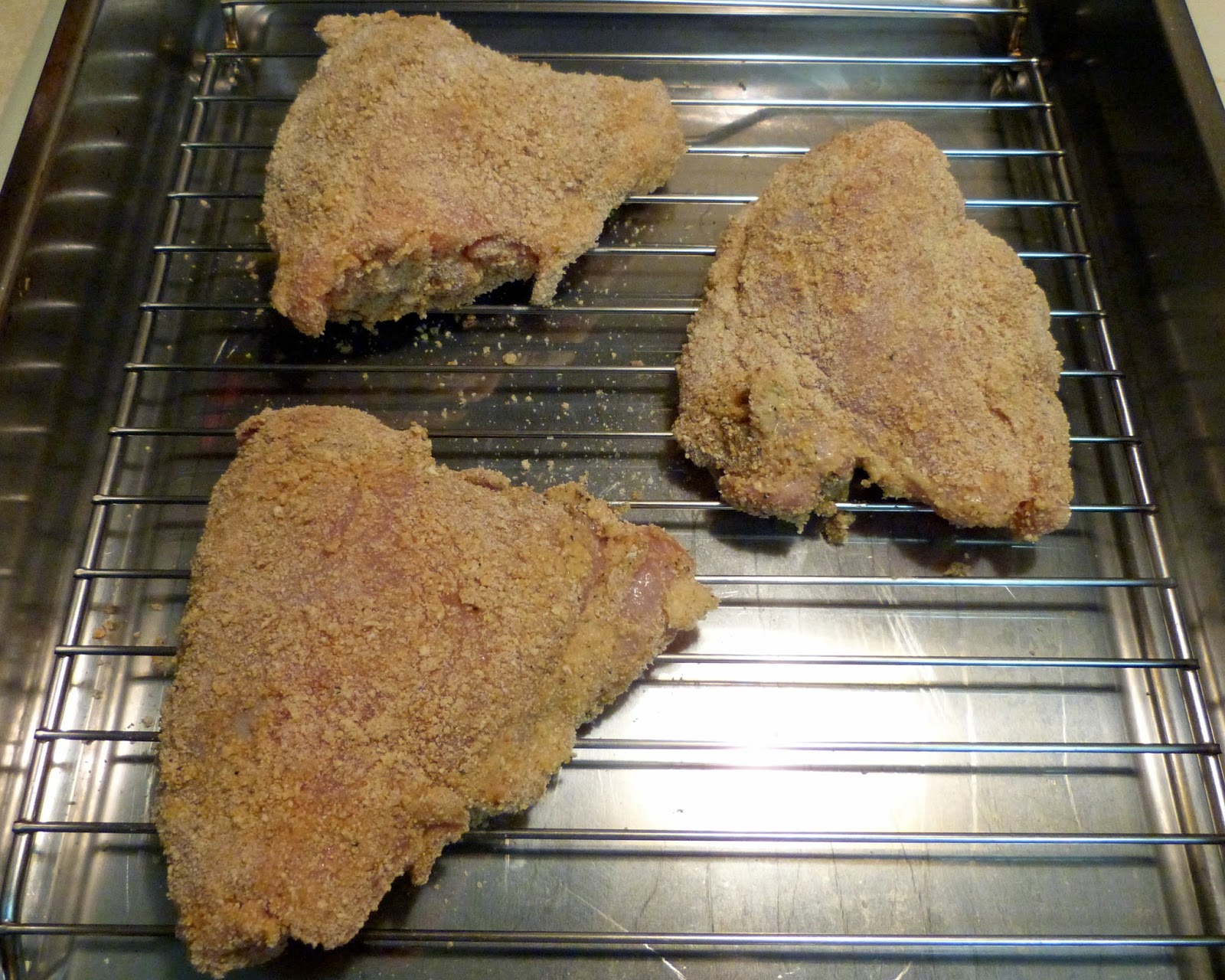
Breaded Baked Chicken

Breaded chicken is one of my old standby recipes, and one I've been making for years now, and it's been a long time coming on this blog. I actually had to check back at the old posts just to make sure it hadn't been covered already! It's very simple, made from ingredients I always have on hand, and is always a hit in our house.


This recipe can be used as a baseline for experimentation. I have substituted fat free Greek yogurt for the mayo, and that also turned out great. You can also add some herbs to the mixture.

Ingredients
  • Bone-in chicken pieces (legs and thighs work well)
For each chicken piece
  • Salt and pepper to taste
  • 1/2 Tbs light mayonnaise
  • 1/2 Tbs Dijon mustard
  • Dash of Sriracha chili sauce
  • Bread crumbs

Instructions

Preheat oven to 425 degrees. [Note: I am not sure our rather aged oven is showing the temperature accurately, so this may be slightly high]

Combine the mayonnaise, mustard, and sriracha sauce in a bowl and mix thoroughly. Spread breadcrumbs on a plate. Remove skin from the chicken, and dust each side with salt and pepper. Liberally rub the mustard and mayo mixture over each piece, then press into breadcrumbs to coat.


Bake the chicken until cooked through and browned on the outside, about 40-45 minutes. I like to cook them on a wire rack over the pan.

Sunday, October 5, 2014

Panko Crusted Salmon

Today, dear readers, you bear witness to one of my proudest culinary moments: how I was able to introduce salmon into our home. Until recently, Ariel was not much of a fish eater. I have  been experimenting with cooking various kinds of fish, and many have met her approval. Catfish, tuna, and the delightfully named swai (a sort of Vietnamese catfish, a steal at $3.99 a pound) have become dinner staples. Yet one remained off limits, the elusive salmon.


My first attempt, grilled, met a lukewarm response, but it was this panko breaded fillet that sealed the deal. So, anyone trying to convince a friend or loved one to see the fishy light, give this a try. This recipe is easily adapted to many other fish. It can also be done with steaks as opposed to fillets. I used this technique recently for albacore tuna steaks, and it turned out great. Credit goes to Serious Eats' Food Lab for the original inspiration for the dish.

Ingredients
  • Salmon fillets
  • Salt and pepper
  • Flour
  • 1 egg
  • Panko breadcrumbs
  • Vegetable oil

Instructions

Begin heating vegetable oil in a frying pan, about halfway between medium and medium high heat. Use just enough to cover the bottom of the pan.

Cut the salmon into serving portions. Salt and pepper each side. On skinless fillets, we can identify the "skin side" of the fillets by the grayish strip that runs down the center. I bread this side because it tends to be more uniformly flat. You can bread the other side, but the coating may not brown as evenly.


Beat the egg in a bowl. Dredge the skin side of the fillets in flour, dip in egg, and press firmly into the panko. Make sure the skin side is well coated.


Once the oil is hot, carefully place the fillets in the pan, breaded side down. Cook for about 2 minutes, turn over, and cook for 2 more minutes. The breading should be well browned. If the fillets are relatively thick, you may want to cover the pan for part of the cooking. Serve with a wedge of lemon.

Sunday, February 12, 2012

Wiener Schnitzel vom Schwein

I love Wiener Schnitzel. My appreciation of the dish probably originates while traveling in Germany and Austria many years ago; since "Wiener Schnitzel" is one of the only German phrases I know, I ate a fair amount of it. Wiener Schnitzel is most associated with Austria ("Wien" being the local name for Vienna), but it is popular all over Europe and worldwide. In Italy, they have the cotoletta alla milanese, which is cooked bone-in in butter. In Japan, the meat is breaded with panko and served with a sauce as tonkatsu. In Indiana, we have the breaded tenderloin sandwich. Schnitzel is traditionally made from veal, but pork is commonly used, especially outside of Austria, where the pork variation must legally be called Wiener Schnitzel vom Schwein. 


Ingredients
  • Pork loin, sliced
  • 1 Egg
  • Flour
  • Breadcrumbs
  • Salt and pepper
  • Wedge of lemon
  • Vegetable oil

Instructions 
With a sharp knife, trim the fat off the sides of the pork. If you have really big, thick slices, consider butterflying the meat also. Cover with plastic wrap and pound thin, to about a quarter inch thick. If you don't have a good meat hammer, use a soup or bean can. I find the plastic wrap stops the hammer from sticking to the meat. It also prevents your soup from getting all meaty.

Prepare two plates, one with flour and one with breadcrumbs. Beat an egg in a bowl. We are now ready to prepare the cutlets. Generously salt and pepper each side of the pork. Then press each side into the flour to coat. Next, dip in the egg, making sure to coat well. Finally, press into the breadcrumbs and thoroughly cover both sides.


We will shallow fry the cutlets. Heat oil in a flat-bottomed pan. You don't need to use too much oil, enough to cover the bottom of the pan, but you don't need to submerge the cutlets. As with all breaded foods, you need to be careful about the oil temperature. You want it hot enough to get the breading nice and golden brown, but not too hot to burn. I find that the right temperature is somewhere between medium-high and high. Once the oil is hot, carefully lay the cutlets in the pan. Cook for about 3 minutes on each side. Turn the cutlets over very carefully with a fork, as to not disturb the breading. This is important to get the right texture and beautiful golden brown color on your schnitzel.


When finished cooking, let the schnitzel rest on a paper towel to dry off a bit. The traditional Austrian way is to serve with lemon wedges to squeeze over the schnitzel before eating. I should also note that the pork may remain a bit pink when you cut into it; this is completely safe. For drinks, we again go to lager, this time as a tribute to the region of origin. You can't go wrong with German, Austrian, or Czech here.

Thursday, January 19, 2012

Beer-Battered Tilapia

Pub Week, Day 5. Fish and chips are an absolute pub classic, as well as popular street food in the UK. Here I have put a few twists on the traditional formula. I've swapped cod for tilapia, which is readily available in US grocery stores. I also chose to make roasted potato wedges instead of french fries (chips). The recipe for the potato wedges will be posted next week. The exact formula for the batter is still something of a work in progress - you may desire to add a bit more flour, or perhaps some spices. Ideas are welcome in the comments!


Ingredients
  • 2 tilapia fillets
  • 1 cup all-purpose flour
  • 1 cup Guinness stout
  • 1 egg
  • Salt and pepper
  • Malt vinegar
  • Oil for frying

Instructions

Pour flour and Guinness into a bowl. When pouring the beer, try to pour against the side to stop the creamy head from forming. Crack the egg into the batter, and lightly season with salt and pepper. Whisk together thoroughly.


If you look at the tilapia fillets, you will notice they have a natural divide down the center. Slice each fillet in half, so that they'll be more manageable to cook. Lightly salt, pepper, and flour each side, then dip in batter to coat. Drop each piece into the oil, taking care not to crowd the oil or let the fish pieces stick together. I did two pieces at a time in my small fryer. Cook for about 6 minutes.

Serve immediately to retain crunchy exterior. Pour malt vinegar over the fish and salt to taste before eating. This recipe, along with the potatoes, makes 2 servings. There is more than enough batter here to fry a lot more fish than just our two fillets, so keep that in mind if multiplying the recipe.

Tuesday, January 17, 2012

Scotch Eggs

Pub Week, Day 3! I've been a fan of scotch eggs for a long time, but I had never made them before. I first ate them at the Minnesota Scottish Fair, state fair style - on a stick. As luck would have it, my wonderful girlfriend gave me an electric deep fryer, so today was a perfect opportunity. As it turns out, scotch eggs are actually pretty easy to make, with very common ingredients. This recipe makes two scotch eggs.


Ingredients
  • 3 large eggs (2 for boiling, 1 for egg wash)
  • 1 link raw pork sausage, or equivalent bulk sausage
  • Flour
  • Bread crumbs
  • Salt and pepper
  • Oil for frying

Instructions

Start by hard boiling the eggs. Fill a pot with cold water, submerge eggs, and bring to a boil. Once the water starts boiling, remove from heat and let stand for 10 minutes. Remove the eggs and set aside to cool. This can be done well in advance.

A note on sausage: I always buy link sausage, for two reasons. First, as a person living alone, it is very easy to freeze the individual links for later. Second, you can always de-case the links. I used Italian sausage here, but use whatever kind you have.


If using links, de-case the sausage. Conveniently, a regular sized link will be perfect for two scotch eggs. Divide the sausage in half and form into thin patties. Flour both sides of the patty and lay a peeled egg on it. Wrap the sausage up and around like a blanket, working it with your fingers until it thins and covers the whole egg. Make sure it's secure and there is no egg showing. This is actually a lot easier than I was expecting - the sausage stays on very nicely.


Preheat oil in a pot or deep fryer. You want the oil to be hot enough to get the breading nice and crunchy, but not too hot so that it will burn. Crack the remaining egg into a bowl and beat with a fork. Pour breadcrumbs into a shallow bowl or plate, and season with salt and pepper. Roll each sausage-egg in the egg wash, then in the breadcrumbs, and carefully drop into the oil. You can fry two eggs at a time. Cook in the oil for about 4 minutes, then let them rest on a paper towel for a few minutes. Carefully cut the eggs in half with a serrated knife.

You can enjoy your scotch eggs hot or cold. They are great on their own or with a dipping sauce. I whipped up a quick spicy mayo using regular mayonnaise, smoked paprika, a little garlic powder, and a few squirts each of Sriracha and Worcestershire. You can also use a straight hot sauce or anything you like.