Wednesday, April 11, 2012

Coconut Shrimp Curry

Today's recipe is a pan-Asian inspired shrimp curry. The shrimp are seared ahead of time and added back to avoid overcooking, which can produce some unimpressive results. For the pepper, I used a poblano, but bell peppers are probably better because they are a little more tender. Your pepper choice will also affect the spiciness of the dish. It's really up to your preference. For those who don't know it, garam masala is an Indian spice blend that you can usually find in an Asian grocery store. Enterprising folks could even make it themselves. Garam masala is what gives Indian food its distinctive, spicy flavor.


Ingredients
  • 6 large shrimp
  • 1/2 lime
  • 1 green pepper
  • 1/2 onion
  • 1 1/2 tsp garam masala
  • 1/2 tsp turmeric
  • 1/4 tsp ground mustard
  • 1/2 tsp dried basil
  • 1 cup coconut milk
  • 1/4 cup water
  • Salt, pepper, and coriander

Start by peeling and cleaning the shrimp. Put in a bowl and squeeze the lime juice over them. Season with salt, pepper, and a little coriander. Refrigerate for about 20 minutes. Heat oil on medium-high in a saute pan. Sear the shrimp on both sides and set aside. 


Cut the onion and pepper into slices. Remove the seeds from the pepper. Add more oil to the pan, and heat on medium. Add garam masala, turmeric, mustard, and basil, then the pepper and onion. Stir well and cook until vegetables are softened.


Add the coconut milk and water. The coconut milk will provide the flavor base, while the water will thin out the sauce a little. Add shrimp and simmer for a few more minutes. Stir to integrate everything. Taste the sauce and add salt to taste. Serve with basmati rice.

Monday, April 9, 2012

Cold-Brewed Iced Coffee

No Free Lunch has returns with a recipe to bring us into the warmer months. Grandpa loves iced coffee, and he definitely passed that on to me. Depending on the temperature outside, a visit to Grandpa's house will almost certainly result in either a hot or iced coffee. If it's iced, expect a scoop of ice cream, too. My variation is a coffeehouse favorite; instead of cooling off hot coffee, here we cold brew overnight. Heat brings out the flavor faster, but with it more acidity. That's why we need to brew for so long. Another good variation is Vietnamese style, adding sweetened condensed milk.


Ingredients

Coffee (makes 4 glasses)
  • 4 cups cold water
  • 90-100 grams coffee beans, ground

For each glass
  • 1 cup coffee
  • 3 ice cubes
  • 1 tbs half and half
  • 2 tsp sugar

Instructions

The coffee is made in advance. You can brew it in any kind of container - a bowl, carafe, pot, whatever works, as long as you can strain out the grinds later. The most convenient way is to use a large French press, since you can easily strain out the grinds. Add the grinds to the French press and pour water over them. Stir gently with a chopstick. Leave to brew for at least 12 hours. Once the coffee is ready, pour into a carafe. You can keep this refrigerated for quite a while if you want.


To prepare a glass of iced coffee, combine ice, coffee, half and half, and sugar, and stir. You may wish to crack the ice with the back of a spoon first. For a special treat, add a scoop of vanilla ice cream to your iced coffee.

Monday, April 2, 2012

Minnesota Hotdish

I'm going back to my roots for this one. No matter how many delicious Indiana pork tenderloins you feed me, there will always be a place in my heart and belly for hotdish. There's just something so endearing about a food that you dump a can of soup into. Comfort food at it's finest. This recipe is the perfect complement to the mushroom soup-based casserole from January. I, perhaps like many Minnesotans, am lucky to have casseroles from both sides of the family. This is a dish Mom grew up eating, and I made sure to call for some tips before making it.


Ingredients
  • 2 1/2 cups dry elbow macaroni
  • 2/3 pound ground beef
  • 1/2 medium onion
  • 1 cup diced tomatoes with juice
  • 1 can tomato soup
  • 1/6 cup breadcrumbs
  • Salt and pepper
  • Vegetable oil

Instructions

Preheat oven to 375 degrees. Boil salted water in a pot. Cook the macaroni for 10 minutes in the boiling water.


Dice the onion. Heat some oil in a frying pan on medium-high heat. Fry the onions until soft, then add beef and season with salt and pepper. Remember, other seasonings would be so un-Minnesotan. Brown the beef. Add the diced tomatoes and tomato soup. Mix together and heat briefly.


In a casserole dish, combine the beef, onion, and tomato mixture with the macaroni. Mix thoroughly, then sprinkle breadcrumbs evenly on top. Bake for 30 minutes. If you desire a softer, gooier texture, bake longer. You may also want to broil for a few minutes to brown the breadcrumbs on top. Make sure to watch it so it doesn't get burned.

Saturday, March 31, 2012

Tomato and Egg

During my time in Shanghai in the summer of 2009, I encountered many interesting foods. Tomato and egg quickly became a staple of our diets. You could buy a bowl of rice and a plate of tomato and egg for next to nothing. Although very common in China, the dish is relatively rare in American Chinese restaurants, although Carnegie Mellon's esteemed eatery Asiana, to their credit, does serve it. As I note below, juicier tomatoes make this even better, as the juice naturally forms the sauce. This dish marries perfectly with white rice, as the juice integrates nicely. For me, the perfect accompaniment to this nostalgia-laced dish would be a bottle of Tsingtao.


Ingredients
  • 4 large eggs
  • 2 tomatoes (the juicier the better)
  • 1/4 medium sweet onion
  • 1 clove garlic
  • 1/4 tsp sesame oil
  • 1/2 tsp sugar
  • Salt and pepper
  • Vegetable oil

Instructions

As with making fried rice, we'll do the eggs first. In a bowl, beat eggs and add sesame oil, salt, and pepper. Heat a little oil in a wok and cook the eggs until the liquid is gone, but they are still soft. As always, avoid overcooking scrambled eggs. Set aside.


Clean the stuck egg bits out of the wok, and add more oil. Slice the onion into strips. Cook on medium-high heat until softened. Once the onions go in, mince the garlic and add to the wok. While this cooks, cut the tomatoes into wedges. I cut 12 wedges out of each one. Once the onions are nice and soft, add the tomato wedges. Cook covered until the tomatoes are heated through. Add sugar and eggs. Mix well, and cook together briefly. Serve with rice.

Thursday, March 29, 2012

Irish Coffee

The inspiration for this post came a few weeks ago when I saw the last five minutes of an episode of Blue Bloods. Tom Selleck's character and his glorious moustache were showing his family how to pour the perfect Irish coffee. I had intended to get this one out for St. Patrick's Day, but as you can see, that did not happen. As it turns out, I didn't get it right until my fourth attempt. It seems that the key to this classic cocktail is to beat the cream and add lots of sugar to the coffee. My version is weaker than the International Bartenders' Association standard, using only one shot of whiskey, which to me is quite sufficient. This makes for a very smooth, tasty drink.


Ingredients
  • About 1 cup freshly brewed hot coffee
  • 1 shot Irish whiskey
  • 2 tsp brown sugar
  • Heavy cream

Instructions

Get the coffee started first. You can make this in any way you like. I prefer to use a one-cup French press for its ease of use. I grind up about 15 grams of beans, add those to the beaker, and pour hot water over them. Brew for 5 minutes.

Traditionally, Irish coffee is served in stemmed glass mugs. Since I don't have actual Irish coffee mugs, I used a wine glass instead. Fill the glass with hot tap water to warm it up. Pour cream into a bowl and whisk to thicken. Don't take it all the way to whipped cream. Transfer the cream to a container that's easy to pour from, such as a beaker or measuring cup. I find that the cream is more likely to float if you do this.

Once the coffee is ready, empty the water from the glass. Add the whiskey and coffee, filling up until there is about a half inch from the top of the coffee to the rim of the glass (more if you like extra cream). Add the brown sugar and stir it into the coffee. From what I've read, this is an important step for the floating of the cream, so do this even if you're a black coffee-guzzling Minnesotan.

The last step is the most important for the presentation of the drink. Lower a small spoon, backside-up, into the glass, with the end barely touching the coffee. Slowly pour the cream over the back of the spoon. If all the steps have been done correctly, the cream will float on top. Do not mix it in. The coffee should remain black below, and not clouded with cream. Serve immediately.

Tuesday, March 27, 2012

Stir Fried Rice Cakes (炒年糕)

Note: this recipe has been updated! See Rice Cakes Revisited for more.

Never before have I struggled so much to come up with a title for a blog post. These things just have no good translation. Due to the shape of the rice cakes, my family has always called them "tongue depressors." Until now, I have not tried to ascertain their true name. Some internet searches revealed one possibility is Shanghai Niangao, niangao being a somewhat generic term for all types of rice cake. Once cooked, the rice cakes are basically a thick, wide noodle. The consistency is very soft and they almost melt in your mouth.


It was always a special treat when grandpa and grandma would make these, since they are exceedingly rare in places where people don't speak Chinese. You can, however, sometimes buy a package of the dried rice cakes in Chinese grocery stores. Look for a package with the words "白粿乾," "White Rice Cakes" or "White Rice Slices." I should add also that this is a really cheap meal. The whole package of tongue depressors was less than $2. The cabbage used is only a small fraction of a head, and the green onions would cost about 50 cents total. Ground pork is also one of the cheaper meats you can buy.

Ingredients
  • One bag (350 g) dried white rice cakes
  • 1 pound ground pork
  • 2 cups coarsely chopped cabbage
  • 1/2 cup chopped green onion
  • 1 Tbs soy sauce
  • Salt and pepper
  • Vegetable oil

The finest super quality.

Instructions

Be aware that you need to plan to eat these at least a day in advance. Soak the rice cakes in water for about 24 hours. Change the water every once in a while (I did it three times). The rice cakes will absorb water and become less brittle. Interestingly, during the second half of the soaking period, a vague fragrance filled my whole apartment.

Pictured after soaking.

After soaking, cook the rice cakes in boiling water for 5 minutes. This roughly coincides with the rice cakes floating. Take them out immediately and drain. Don't overcook them, or they will become too mushy and sticky, which they already are to begin with.


While the rice cakes are cooking, heat up a wok on high heat. Add a small amount of vegetable oil. Add the pork and season with salt and pepper. Break up the pork and brown it all over. Add green onions and cabbage. Toss together as everything cooks. After another minute, pour in the rice cakes and soy sauce. Toss for another minute or two to get it all integrated. Make sure to keep all the food moving once you add the rice cakes so that nothing gets burned. Serve immediately.

Saturday, March 24, 2012

Matzo Ball Soup

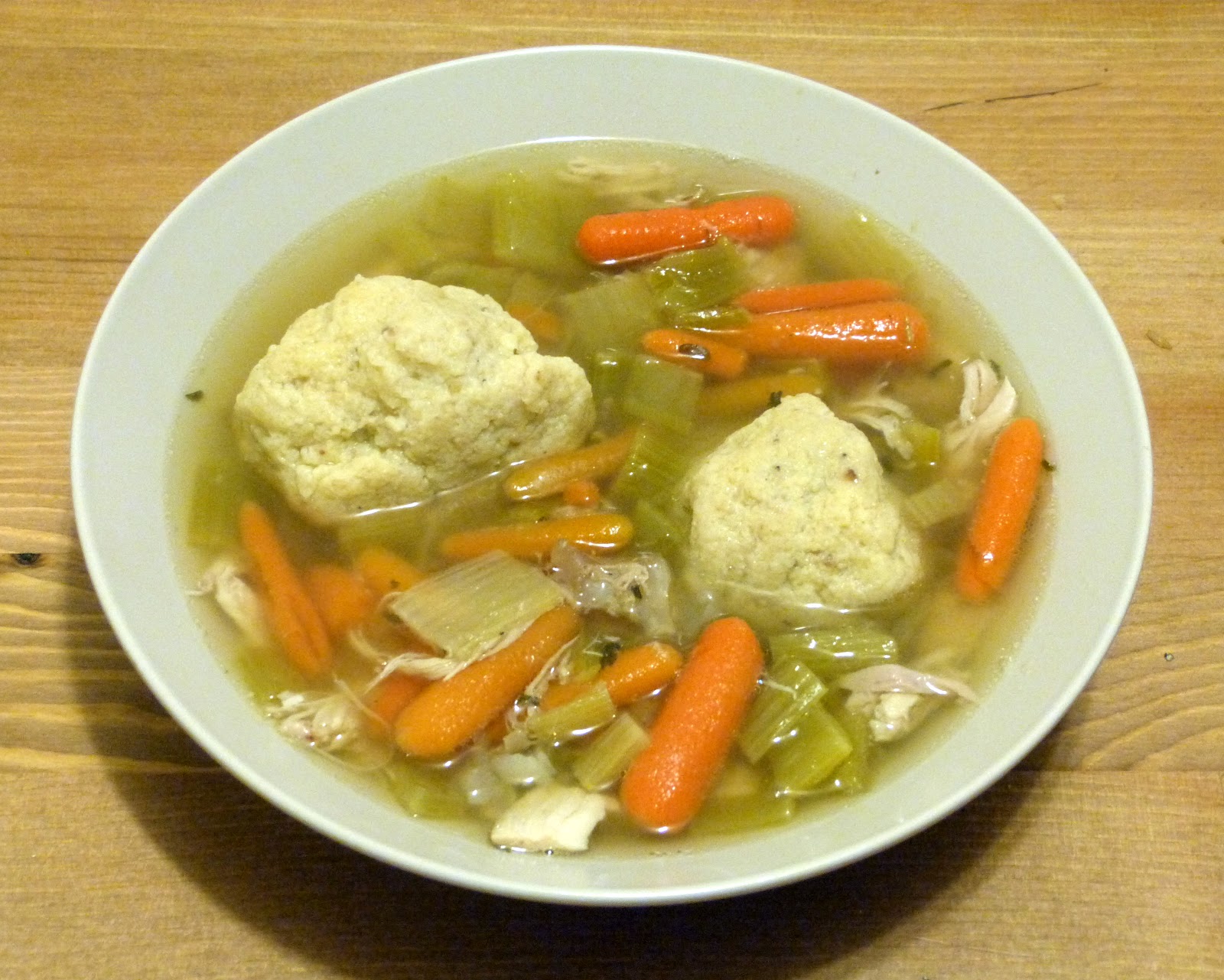
Welcome to a very special edition of No Free Lunch. For the first time, I'm featuring a dish not made by me. Ariel so kindly made me a pot of Matzo Ball Soup with the secret family recipe, to which you, my dear readers, are now privy to. With great power comes great responsibility; use this information with care. This soup is relatively simple in ingredients, but it is very tasty. The matzo balls are soft and tender, but they don't fall apart either. The chicken, cooked for 3 hours, falls right off the bone. This soup is quite reminiscent of the chicken and dumpling soup typically enjoyed by us gentiles, but the matzo balls are on a scale like nothing I've seen since experiencing the knödel of Germany.


Ingredients

Soup
  • One whole chicken
  • 1 bag baby carrots
  • 1 bag celery
  • 1 large onion
  • Dried parsley
  • 2 bay leaves
  • A lot of Salt
  • Black pepper
Matzo Balls
  • 4 eggs
  • 1/2 cup cold water
  • 2 Tbs oil
  • Dash pepper
  • 1 cup matzo meal

Instructions

Soup

Cut the chicken into quarters. Place chicken, carrots, onion, and celery in a large stock pot. Fill up the pot with water. Sprinkle a bit of parsley and black pepper. Generously salt the water, remembering that the pot is large and there is a lot of soup in there. Add bay leaves and bring to a boil, then reduce to simmer. Simmer for 3 to 4 hours.

Consider the gargantuan scale of this pot.

After simmering, fish out the onion and bay leaves, and discard them. Take out all the chicken and discard all bones, skin, and other undesirable parts. Set the chicken meat aside until serving.

Matzo Balls

Crack eggs in a bowl and beat. Add water, oil, and pepper. Mix together. Add the matzo meal and mix this in as well. Refrigerate the mixture for 1 hour.

Matzo meal mixture before forming balls

Form into balls no more than 2 inches in diameter. Size is up to your preference. Be aware they will absorb water while cooking and swell somewhat. Bring water to a boil in a large pot. Salt the water like you were making pasta. Cook the balls for 20 minutes. Push them down once when they float.

Matzo balls after cooking

To assemble the dish, heat up the chicken separately. Add however many matzo balls you and your pals intend to eat into the soup. Heat up the soup on the stovetop. Put the chicken in bowls and pour soup over them. Add matzo balls to each bowl.

Thursday, March 22, 2012

Yangzhou Fried Rice (揚州炒飯)

With a large stockpile of char siu now on hand, we now have one of the most recognizable Chinese dishes - Yangzhou fried rice. This is a far cry from the simple fried rice which was the first recipe on No Free Lunch. Often served as the last savory course of a Chinese banquet, Yangzhou fried rice is characterized by shrimp, egg, and char siu, along with vegetables. As with all my fried rice, this also features the indispensable Worcestershire sauce.


Ingredients
  • 5-6 cups cooked, day-old rice
  • 8-10 marinated shrimp (see below)
  • 6-8 strips Char Siu
  • 1/2 cup frozen peas
  • 3 large eggs
  • 1 bunch green onions
  • 10 splashes Worcestershire
  • 5 splashes soy sauce
  • 3 splashes sesame oil
  • Vegetable oil
  • Salt and pepper
Shrimp
  • 8-10 large, raw shrimp
  • Salt, pepper, and garlic powder
  • 5 splashes soy sauce
  • 1/3 lemon

Instructions

Prepare the shrimp first. If using frozen, defrost with cold running water. Remove shells. Next, de-vein the shrimp. To do this, slice each shrimp down the top, all the way from the head to the tail, then remove the vein. Note that some will have more to get out than others.


Place the shrimp in a bowl. Dust with salt, pepper, and garlic powder to taste. Splash the soy sauce over them, and squeeze in a bit of lemon juice. Let sit for 15 minutes. Heat a bit of vegetable oil in a wok on high. Sear the shrimp on both sides, a few minutes each. Set aside.

Crack the eggs into a bowl and beat. Add salt and pepper. Cook the eggs in the wok on medium-high heat. Cook until there is no more liquid, but the eggs are still soft. Set aside with the cooked shrimp.


Slice the whole bunch of green onions crosswise into small discs. Cut the char siu into bite sized pieces. With a little vegetable oil, stir fry both until hot. Add the rice. Sitting in the refrigerator, the rice will likely have formed into chunks. Break these up as you add them into the wok; the looser, the better. Add the peas. You do not have to defrost them ahead of time; the heat from the wok and rice will thaw them. Add Worcestershire sauce, soy sauce, and sesame oil. Toss to mix everything together. Let the whole thing sit on relatively high heat for a few minutes. Cover if you like.


Once this is done, add the shrimp and eggs. Break up the eggs a little and toss the rice. Let sit for a few more minutes, and serve.