Congee, known as zhou in Mandarin and juk in Cantonese, is a rice porridge popular in many parts of Asia. I recall my grandparents making it from time to time, but my memory for what theirs was like has faded over the years. Until today, I had never attempted to make it, but the cold weather inspired me to give it a go. My research turned up a lot of variation in how it's made, particularly in the rice-to-liquid ratio and the length of cooking time. I'm going for the Cantonese version, which seems to feature one of the lowest (1 to 20) ratios. Over the cooking time, the rice breaks down and thickens the broth. As first attempts go, I think the congee turned out very well, though I have some tweaks in mind going forward and plan to document those.
Showing posts with label soup. Show all posts
Sunday, December 18, 2022
Pork Congee (粥)
My recipe here is based on a combination of the basic juk from ArChan Chan's Hong Kong Local cookbook and the pork congee from Chinese Cooking Demystified. I also consulted a few other sources on the internet. As mentioned above, the 20-to-1 ratio appears to be the standard for Cantonese-style juk, which comes to 1/2 cup rice to 10 cups liquid. I think next time I will increase the rice a bit to get a heartier result. Some recipes out there go as low as 7 to 1. The key to achieving the proper texture in the porridge is by breaking down the rice. Traditionally, this is done with a very long cooking time, but some modern recipes (including Chan's) start by freezing the rice overnight to speed that up. Freezing is known to break down fibers in food. Normally, this is a bad thing, which is why people typically advise not thawing and refreezing meat, but here it works to our advantage.
Congee can start with plain water but often uses stock. Here, I made a simple pork stock from a shoulder bone I had in the freezer. When I break down a shoulder for char siu and other things, I save the bone with a good amount of meat left on it. The meat gets super tender and we sometimes just eat them with a little soy sauce and scallions (known as "pork snacks" in our house). It's natural to toss them in the congee. I made the stock the day before and kept it in the fridge. The rest of the seasoning is simple and can be adjusted to taste - salt, white pepper, ginger, scallion, and MSG (if you want). Congee is a bit of a blank slate and there are many possible add-ins and sides. Century eggs are a popular option. I didn't have them on hand, but will be on the lookout.
Tuesday, August 11, 2020
Egg Drop Soup (木樨湯/蛋花湯)
Egg drop soup seems to be one of the few dishes that made it from actual Chinese food into American Chinese restaurant fare largely intact. This recipe is an adaptation of Joyce Chen's recipe from the Joyce Chen Cook Book. It is a very simple soup that can be thought of as a base to add other ingredients, if you so choose. The most common Chinese name I've found is danhuatang (蛋花湯), which means "egg flower soup." It's one of the many Chinese food names that describes the appearance of the food, since the egg strands are supposed to resemble flower petals. Joyce Chen uses the name muxitang (木樨湯). The word muxi refers to the sweet osmanthus, a plant with small yellow flowers which bear some resemblance to scrambled eggs. Definitely one of the more interesting translations we've had lately!
In her book, Joyce Chen precedes egg drop soup with a recipe for a classic Chinese-style chicken stock, which involves a whole chicken. Instead, I made mine with some thigh bones I saved from the chicken and mushroom sandwiches and wing tips I saved from noble consort chicken. I simmered these with some ginger and scallion for about 2 hours. This can be done well ahead of time, and as with shrimp stock, it can be frozen. As usual, I recommend not salting the stock. If working with salted stock, you'll need to cut back the salt in this recipe. As I did not add any wine to my stock, I added a bit more than Chen recommends in the final soup.
We had some soup left over, which held up just fine after a few days in the refrigerator and reheated in a saucepan. I assume a microwave would also work, but ours finally died about two years after we discovered it in our basement when we bought the house. Soup is easy, but other leftovers have presented a bit of a challenge!
Wednesday, July 22, 2020
Shrimp Bisque
Several months ago, Ariel and I attended a cooking class in Sioux Falls led by Lance White, who runs a cafe and catering business. He demonstrated four dishes: Caesar salad, shrimp bisque, a deconstructed beef wellington with mashed potatoes, and cream puffs. While all the food was good, the shrimp bisque, which he presented as a template to produce all sorts of simple soups, was the most interesting to me. Throwing in the shallots and garlic, skin and all, was particularly eye opening. This recipe is my version of the dish I learned from Chef Lance. A traditional bisque has a lot going on, and this recipe is not meant to be that. It is a quick and easy way to get a tasty soup on the table with readily available ingredients.
I appreciated that Lance emphasized cooking by feel and didn't give exact recipes. It was more about applying the techniques and mindset of professional chefs to home cooking. Although I try to be precise in my recipes on the blog, my day-to-day cooking is a lot looser. I have to force myself to measure to write the recipes, which can sometimes lead to overthinking things. Any of the proportions here, like most of my posts, can be adjusted to taste.
The main difference from the original is that I make a homemade shrimp stock, where he used Better than Bouillon lobster base. I'm unable to get that around here, but with my stockpiles of frozen shrimp shells, making my own stock is no problem. What I do here is very similar to my Chinese stock, but I use the classic French mirepoix instead of ginger and scallion. Doing this increases the time required, but it's a mostly unattended 2 hours that can be done well in advance. I also make double the needed stock, so the next time I can just defrost and go. I am also continuing to experiment with potato starch as a thickener. The original used corn starch, which is perfectly fine, too.
Monday, June 29, 2020
Chinese-Style Shrimp Soup Stock
In quite a few posts, I've referenced my homemade Chinese soup stock. Most recently, it showed up in my corn fish recipe, and it also pops up in a lot of Pei-Mei recipes. Usually, a small amount is used to form the basis of a sauce for a stir fried dish. In a pinch, you can (I have many times) substitute a western-style stock, but I try to always keep some Chinese stock on hand. Compared to the western style, Chinese soup stock is mostly clear and is very simple to make. Take some kind of meat waste, such as bones, carcasses, or shells, and simmer with scallion and ginger. Take a look at just a few of the dishes you can make with this stock!
![]() |
| Sichuan-style eggplant, stir-fried rice cakes, fish with corn sauce, fish with fermented black beans, spring rolls, minced pigeon lettuce cups |
Taking something that would otherwise go to waste and making something useful is very rewarding. Luckily, a lot of these waste parts are key ingredients in making pantry staples. I like to call this "using every part of the buffalo." This includes saving bits of chicken skin and fat for schmaltz and pork fat for lard. I also save scraps of vegetables, bones, and shrimp shells for stock. This particular stock uses shrimp. I always buy shrimp with the shells on and save the shells. I put the shells in a Ziploc bag, fill it up with water, and freeze. Once I have enough of these frozen shell blocks, I make some stock.
This is a very loose recipe because it doesn't require any precision. Pork or chicken bones can be used instead of shrimp for a different flavor. Shrimp gives the stock a subtle seafood flavor that works well in a variety of dishes and also as a broth for wonton soup. I add no salt to the stock, since it's headed for so many different uses down the road. This way, I have full control over the seasoning later. You'll need to add a lot of salt if using for soup. The stock lasts maybe a week in the refrigerator, so I always freeze it. Since only a small amount is used for most recipes, freezing it all in one block is not practical. I've come up with what I think is a clever solution: shattering it into small pieces with a hammer. Very satisfying.
Thursday, July 14, 2016
Soupe à L'Oignon Gratinée
Bonne fête! Welcome to another No Free Lunch Bastille Day special. Having been busy with the move and the class I'm teaching, the blog has, unfortunately, been neglected of late. You'll now notice the third kitchen to be regularly featured premiering in this post. In the time since my last post, I've fallen back on the old favorites, including another huge batch of potstickers. There's nothing like a yearly tradition to drag me out of my torpor. My choice for this year's recipe is about as classic as they come: onion soup.
I've been a big fan of onion soup for about as long as I can remember, yet for whatever reason, I never made it until today. In general, as much as I enjoy soups, I rarely make them and even less often feature them on the blog. This was also a great opportunity to give our new soup bowls a try. I consulted both Julia Child and Kenji Lopez-Alt's recipes, and took some inspiration from both. Onion soup very simple in terms of ingredients, but it all comes together beautifully. The wine I used was the 2013 Chardonnay from Bloomington's own Oliver Winery. The bread was, of course, the one featured on this blog.
Basic Soup
- 2 lb. yellow or sweet onions, or a mix of the two (4-5 onions)
- 3 Tbs butter
- 1 Tbs vegetable oil
- 1 tsp salt
- 1/4 tsp sugar
- 2 Tbs flour
- 6 c chicken stock
- 1/2 c dry white wine
- 2 bay leaves
- Salt and pepper to taste
- 3 Tbs cognac (optional)
For Gratinée
- French bread (enough to cover the bowls)
- Olive oil
- 1 clove garlic
- Grated Swiss cheese, such as gruyère or emmental
Instructions
Slice the onions into thin strips. Melt butter with vegetable oil in a large dutch oven or heavy pan over low heat. I ended up splitting my onions across two pans, as in the photo. Add onions, cover, and cook 15 minutes. Turn the heat up to medium-low and add salt and sugar. Cook until golden brown, stirring frequently. For me, this took about an hour.
At this point, I combined all the onions into one pan. Add flour, stir together, and cook a few minutes. Add wine, stock, and bay leaves. Bring to boil. Reduce to simmer and cook, partially covered, about 40 minutes. When ready to serve, stir in the cognac, if using.
To prepare the toast, slice French bread and brush with olive oil. Toast until hard and crunchy. Cut garlic in half and rub on the toast.
Transfer the soup to oven-safe bowls. Top with the toast and cover with cheese. Broil the bowls for a few minutes, until the cheese is bubbly.
| Headed to the broiler |
Transfer the soup to oven-safe bowls. Top with the toast and cover with cheese. Broil the bowls for a few minutes, until the cheese is bubbly.
Sunday, June 28, 2015
Dashi
Katsudon turned out to be such a hit that I made it again. By that time, I had noticed and bought some kombu (dried kelp) at the Asian grocery, and started looking at dashi recipes. I ended up following Alton Brown's method, which worked very well. As such, I will focus on the ingredients and general usage in this post and simply refer the reader to AB for the nuts and bolts. I roughly halved his recipe.
| Kombu sheet and katsuobushi flakes |
As it turns out, there are only a two ingredients for dashi: kombu and katsuobushi. My investigations turned up that there are two kinds of kombu: lighter, younger kombu for eating and firm, dark, aged kombu for making dashi. This second kind of kombu is usually labeled as "dashi kombu" and comes in large sheets, whereas the kombu for eating comes in smaller strips.
The other ingredient is katsuobushi, which is dried flakes of smoked skipjack tuna. The skipjack tuna is a popular fish in Japan, often used for sushi. The flakes have a strong aroma that reminds me of smoked salmon. Be aware that katsuobushi is often labeled as "bonito flakes," despite the fact that bonito is a different, though similar fish.
I was able to find both ingredients in the Japanese section of the Asian grocery store. Actually making the dashi is very simple. You will also need some cheesecloth to strain out the katsuobushi. The end result is a gentle and light broth that can be used for many things, not just katsudon. Dashi also forms the basis for miso soup. I used it to make a quick and delicious noodle soup. I mixed the dashi with a little sriracha, hoisin sauce, chopped green onion, cilantro, and napa cabbage, then poured this over boiled Chinese egg noodles and fishballs. A bit of a cultural mashup, but quite delicious nonetheless.
Thursday, May 3, 2012
Wonton Noodle Soup
The arrival of this recipe on No Free Lunch is long overdue. Every time I make wonton noodle soup, I strive for it to be "as good as grandma's," and this time came pretty close. In her own words, real Cantonese wonton noodle soup is characterized by thin skins and lots of shrimp inside. These are nothing like the big, doughy wontons you find at the Chinese buffet. Just like any Chinese dumpling, you can make these by the dozens and freeze the ones you aren't going to eat right away. Wontons have a long history in the Wai family. It was always a special treat going to Grandpa and Grandma's house for wontons. Grandpa told us when he was young in Hong Kong, a guy would walk around in front of the apartment buildings selling snack-sized bowls of wontons at night, much to his delight. Take a hint, West Lafayette.
Ingredients
- 1 pound ground pork
- 10 large shrimp
- 2 tbs soy sauce
- 3 tbs chopped chives (or green onions)
- Salt and pepper
- 50 wonton skins
- Chinese egg noodles
- Chicken or seafood stock
- Fresh parsley or bean sprouts
- Chili sauce to taste
Instructions
Remove shells and veins from the shrimp. Cut into small pieces. I sliced each shrimp cross-wise, then sliced each piece in half. Combine shrimp pieces and pork in a large bowl and mix together. Add soy sauce, chives, and a little salt and pepper. Mix thoroughly.
Prepare an open workspace with a large sheet pan and a bowl of water. To assemble each wonton, peel off a skin and spoon a small amount of the filling into the middle. Less is definitely more here. Too much filling and it will be difficult to close the dumpling. Make sure each gets a couple pieces of shrimp.
Dip your finger in the water and run it around the outside edges of the wrapper. Fold each corner together, forming a sort of star shape. Each arm of the star should meet at the middle of the wonton. There are many ways to fold wontons, but this is a simple and easy way to do it. Press each fold firmly to prevent them from opening while cooking.
Bring a pot of water to a boil. Drop the wontons into the water and boil until cooked through. This will take several minutes. One thing you can do to get a feel for it is to drop an unwrapped ball of filling in with the wontons. You can break this open to test for doneness. At the same time, cook the egg noodles for about 3 minutes. When the wontons are done, remove them from the water.
In a large bowl, combine several wontons, noodles, and hot stock. Add chili sauce to taste. I use the ubiquitous Sriracha, but feel free to go stronger if you wish. Top with fresh parsley or bean sprouts. I like to have some kind of greens in the soup, as it adds another dimension of flavor while also being visually appealing. If you want to freeze the remaining uncooked wontons, lay them out on a large sheet so that they are not touching. Once they have been in the freezer a while, you can safely transfer them to a plastic bag, as they will not stick together.
Saturday, March 24, 2012
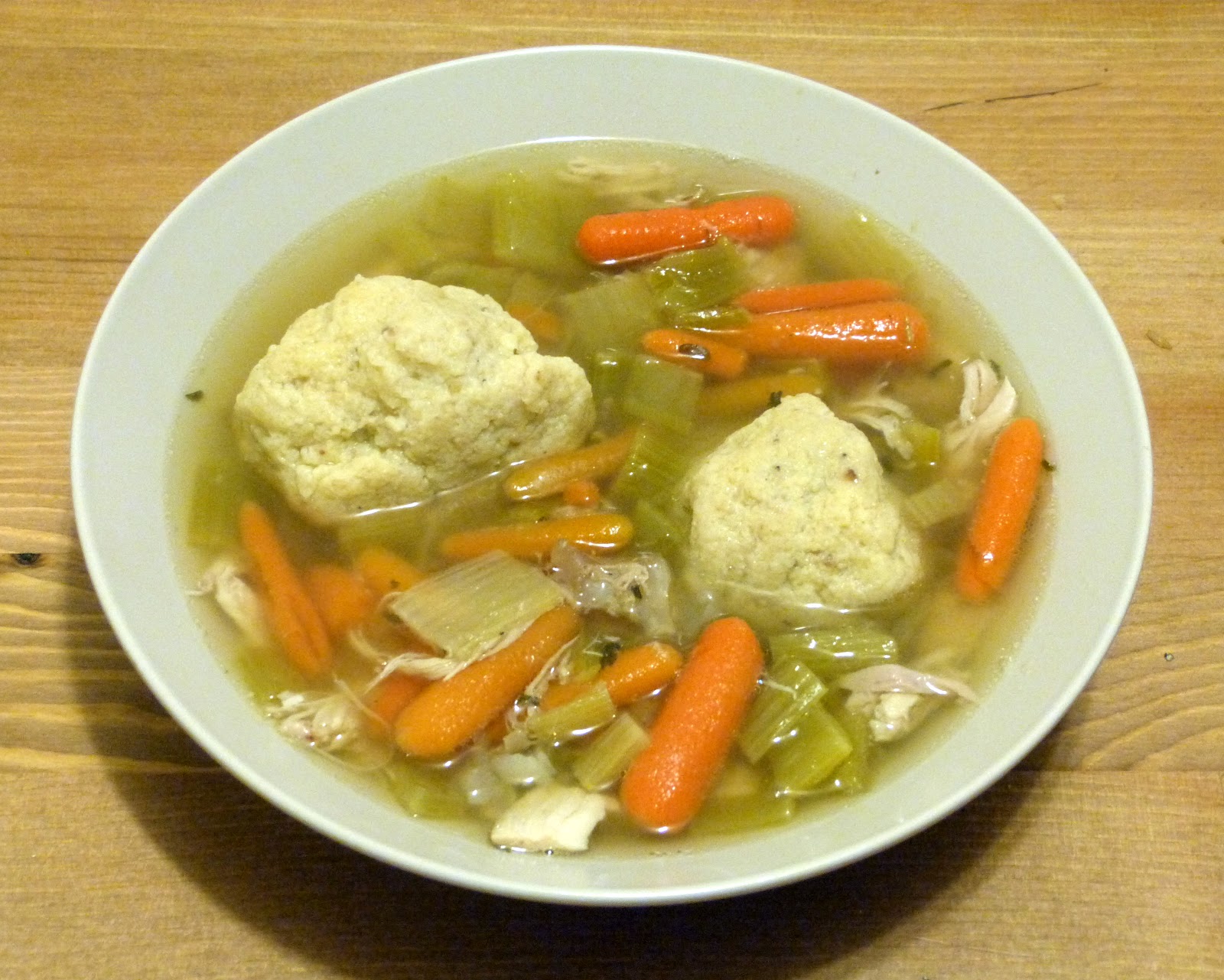
Matzo Ball Soup
Welcome to a very special edition of No Free Lunch. For the first time, I'm featuring a dish not made by me. Ariel so kindly made me a pot of Matzo Ball Soup with the secret family recipe, to which you, my dear readers, are now privy to. With great power comes great responsibility; use this information with care. This soup is relatively simple in ingredients, but it is very tasty. The matzo balls are soft and tender, but they don't fall apart either. The chicken, cooked for 3 hours, falls right off the bone. This soup is quite reminiscent of the chicken and dumpling soup typically enjoyed by us gentiles, but the matzo balls are on a scale like nothing I've seen since experiencing the knödel of Germany.
Ingredients
Soup
Instructions
- One whole chicken
- 1 bag baby carrots
- 1 bag celery
- 1 large onion
- Dried parsley
- 2 bay leaves
- A lot of Salt
- Black pepper
Matzo Balls
- 4 eggs
- 1/2 cup cold water
- 2 Tbs oil
- Dash pepper
- 1 cup matzo meal
Soup
Cut the chicken into quarters. Place chicken, carrots, onion, and celery in a large stock pot. Fill up the pot with water. Sprinkle a bit of parsley and black pepper. Generously salt the water, remembering that the pot is large and there is a lot of soup in there. Add bay leaves and bring to a boil, then reduce to simmer. Simmer for 3 to 4 hours.
| Consider the gargantuan scale of this pot. |
After simmering, fish out the onion and bay leaves, and discard them. Take out all the chicken and discard all bones, skin, and other undesirable parts. Set the chicken meat aside until serving.
Matzo Balls
Crack eggs in a bowl and beat. Add water, oil, and pepper. Mix together. Add the matzo meal and mix this in as well. Refrigerate the mixture for 1 hour.
| Matzo meal mixture before forming balls |
Form into balls no more than 2 inches in diameter. Size is up to your preference. Be aware they will absorb water while cooking and swell somewhat. Bring water to a boil in a large pot. Salt the water like you were making pasta. Cook the balls for 20 minutes. Push them down once when they float.
| Matzo balls after cooking |
To assemble the dish, heat up the chicken separately. Add however many matzo balls you and your pals intend to eat into the soup. Heat up the soup on the stovetop. Put the chicken in bowls and pour soup over them. Add matzo balls to each bowl.
Subscribe to:
Posts (Atom)